
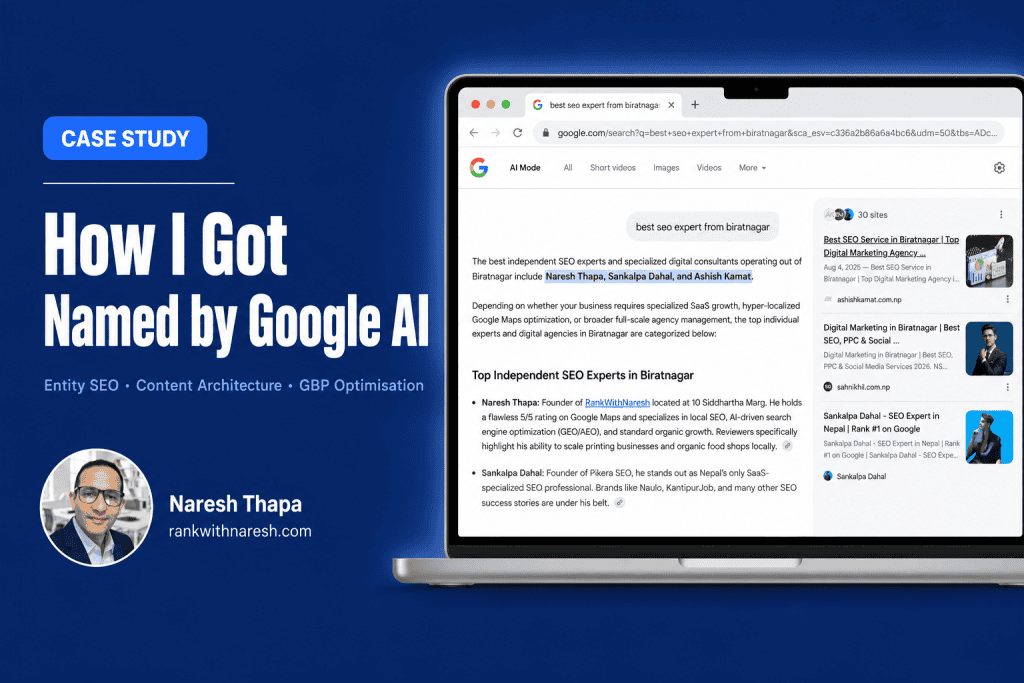
I was not expecting it.
I typed a simple query into Google: "best SEO expert in Biratnagar."
And there it was. Google's AI Overview cited my name. Not in the organic results below. Not in a paid ad. Right at the top, inside the AI-generated answer, alongside just two other names.
That moment changed how I think about SEO. Not because it felt good (though it did). Because it proved something I had been building toward for months. AI systems do not recommend people randomly. They cite entities they trust. And trust is built long before any search query is ever typed.
This case study documents exactly what I built, why it worked, and how you can replicate it.
Google AI Named Me One of Three SEO Experts in Biratnagar
Without a major backlink campaign. Without paid promotion. Through entity SEO, content architecture, and local optimisation.
The Moment Google AI Mentioned My Name
It started with a client conversation. A business owner in Morang asked me a direct question: "If I search for an SEO expert in Biratnagar, will your name come up?" I was confident about my organic rankings. But I had not checked what Google's AI said.
So I ran the search myself. Query: "best SEO expert in Biratnagar."
Here is what I saw.
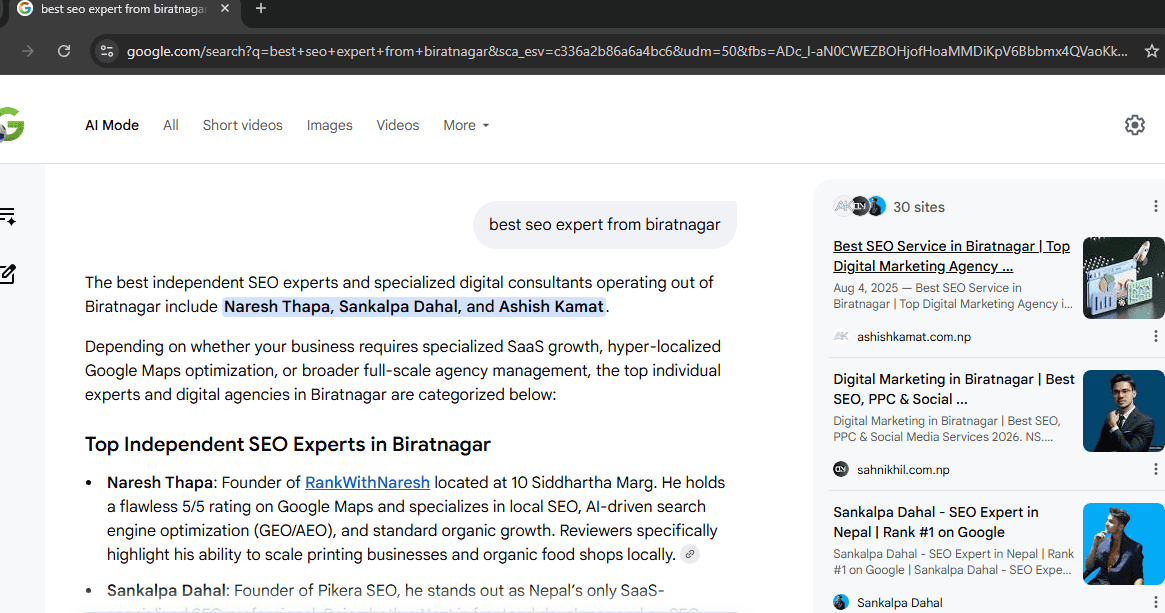
Google's AI Overview pulled my name, my website, and a brief description of my services. The AI did not pull this from a single source. It synthesised signals from multiple places: my website, my Google Business Profile, third-party directories, and my social presence.
That was the moment I realised this was not a small win. It was proof of a strategy working exactly as designed.
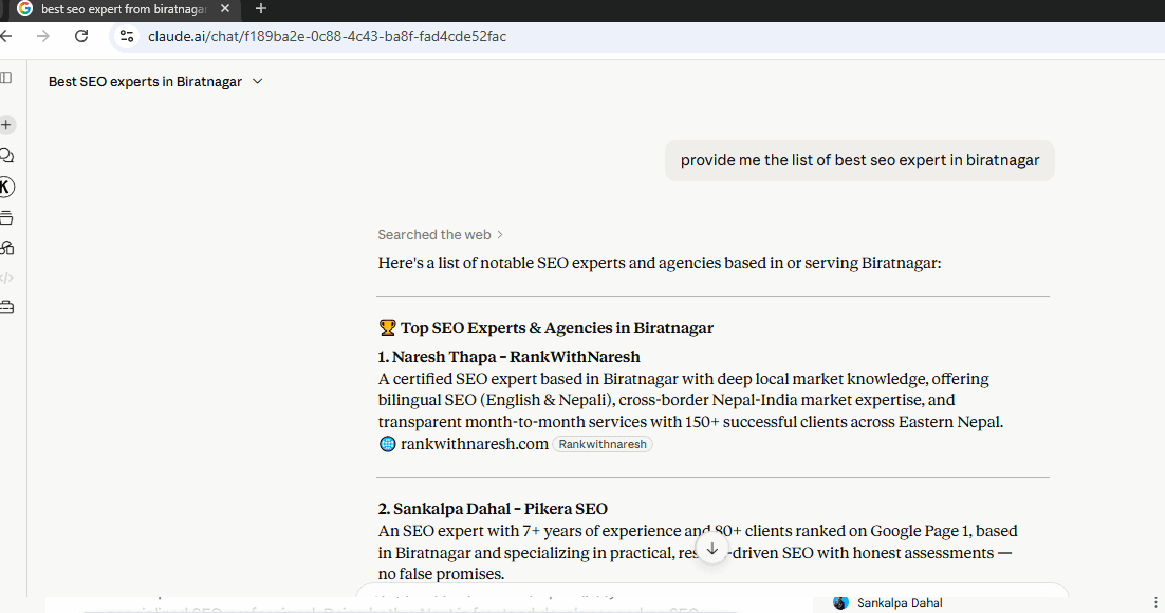
And it was not only Google. The same citation appeared when users queried Claude AI (Anthropic), Perplexity, and other AI-powered search tools. Multiple independent AI systems reached the same conclusion about the same entity.
That is not luck. That is what a well-built entity looks like from the outside.
Why AI Citations Matter More Than Rankings
For years, the goal was simple. Rank on page one. Appear in the top three organic results. Drive traffic from the blue links.
That model is changing fast.
According to data tracked by SEO researchers, AI-sourced website traffic increased by over 500 percent between January and May 2025. Users are now getting their answers directly from AI systems, without clicking through to a website at all. If your name or brand is not in the AI answer, you simply do not exist for that user.
Think about what that means.
A business owner in Kathmandu searches for "best SEO consultant in Nepal." Google's AI gives three names. If your name is not one of those three, that prospect never sees you. Not because your site ranks lower. Because the AI did not mention you.
This is the new visibility layer. And most SEO professionals in Nepal have not built for it yet.
| Traditional SEO | AI Citation (GEO/AEO) |
|---|---|
| Rank in organic results | Get cited in AI-generated answers |
| User clicks your link | AI mentions your name directly |
| Keyword targeting | Entity and topic recognition |
| Page-level authority | Site-wide topical depth |
| Backlink quantity | Cross-platform entity consistency |
| Click-through rate | Citation frequency across AI tools |
For a deeper understanding of these differences, read my guide on SEO vs AEO vs GEO.
Was This Luck or SEO?
Fair question.
It might seem like Biratnagar is a small enough market that one active website could get mentioned easily. And there is some truth to that. Competition in Eastern Nepal is not the same as competing for "SEO expert London."
But here is what matters.
Other professionals operate in Biratnagar. Other websites mention SEO services. Other social accounts post about digital marketing. And yet Google's AI consistently cited my name, my website, and my specific services.
That consistency is not a coincidence. It is the output of deliberate entity building. Let me show you exactly what that means.
The Entity SEO Strategy Behind the Result
Before AI systems cite you, they need to recognise you as a trusted entity. An entity, in SEO terms, is any distinct, well-defined thing: a person, a business, a concept, a location. The stronger and more consistent your entity signals are, the more confident AI systems feel about mentioning your name.
Here is how I built mine.
Personal Entity Building
I made sure every online mention of my name followed the same pattern: Naresh Thapa, SEO Expert, Biratnagar, Nepal, RankwithNaresh. This is the entity core. Every time these four elements appear together, search engines and AI systems add another data point to my entity profile.
NAP Consistency Across the Web
NAP stands for Name, Address, Phone number. My NAP details appear identically across every platform: website, Google Business Profile, Facebook, LinkedIn, local directories, and third-party listing sites.
- Name: Naresh Thapa / RankwithNaresh
- Address: Siddhartha Marg, Biratnagar-10, Koshi Zone, Nepal
- Phone: +977-9767412928
- Email: [email protected]
Any variation in these details, even a small one, creates conflicting signals. AI systems interpret conflicting signals as lower entity confidence. Consistent signals build the opposite: certainty.
Service Association and Geographic Relevance
I tied my entity to specific services and specific locations. Not just "SEO services" in general. But SEO expert in Nepal, SEO in Biratnagar, local SEO in Koshi Province, AI SEO optimization in Nepal. Each association strengthens the entity graph connection between my name and those services in those places.
For more on how I applied this, read the full breakdown of my knowledge graph SEO strategy.
The Content Architecture That Helped AI Understand My Expertise
AI systems do not guess at expertise. They look for evidence of it. And the most powerful evidence is topical depth: a comprehensive, interlinked body of content that covers a subject from every meaningful angle.
The Topic Cluster Model
I built my site around a single pillar page: SEO Expert in Nepal. Every other page on the site connects to that pillar either directly or through topic proximity. This creates a semantic web that tells search engines and AI systems: this entity does not just mention SEO, it comprehensively understands it.
The cluster includes content on:
- What is SEO and how search engines work
- Semantic SEO and entity-based optimisation
- Technical SEO audits and site architecture
- Local SEO for Nepal businesses
- Generative Engine Optimisation (GEO)
- Answer Engine Optimisation (AEO)
- AI search visibility in 2026
- Core Web Vitals and page experience
- Link building for Nepal websites
- Content strategy and SEO writing
Each of these topics has its own dedicated page, internally linked to the pillar and to related cluster pages. This is what topical authority looks like in practice.
Question-Based Content for AI Extraction
AI systems retrieve answers to questions. So my content directly asks and answers questions that my target audience types into search engines.
Instead of: "Here are some tips for local SEO in Nepal."
I write: "How do you rank a local business in Biratnagar on Google?" followed by a direct, specific, data-backed answer.
This structure makes my content easy for AI systems to extract and cite. See how I apply this in my guide on AI SEO content writing.
Specific, Verifiable Data Points
Vague claims are invisible to AI. Specific, verifiable claims are citable. My content includes real numbers: 350+ keywords in the top three, 300% average traffic increase, 47+ home service businesses ranked in Koshi Province, 5 star reviews from verified clients.
AI systems prefer specificity because specific facts are more useful to the user asking the question.
Is Your Content Ready for AI Citation?
Book a free consultation and I will review your content architecture, entity signals, and AI citation readiness in 30 minutes.
How Local SEO Strengthened the Entity
Local SEO and AI citation are more connected than most people realise. When AI systems answer a query like "best SEO expert in Biratnagar," they look for entities with strong geographic association. Here is how I built mine.
City-Specific Landing Pages
I created dedicated pages for every city I serve. Not thin, templated pages, but substantive location pages with local context, client references from that area, and geo-specific service information.
- SEO services in Biratnagar
- SEO services in Kathmandu
- SEO services in Dharan
- SEO services in Jhapa
- SEO services in Itahari
Each page reinforces the geographic association between my entity and each specific location.
Google Business Profile Optimisation
This was one of the highest-impact steps I took. My GBP includes:
- Accurate business name, address, and phone number matching my website exactly
- SEO-specific service categories correctly selected
- 10 verified five-star reviews from real clients
- Regular posts published with local and service-focused content
- High-quality images updated consistently
- Q&A section populated with common client questions
- Business description written with semantic SEO principles
Google's AI Overviews pull heavily from GBP data for local queries. A well-optimised GBP is not optional for local AI citation. It is foundational.
Local Business Directory Listings
I listed RankwithNaresh in local and Nepal-specific business directories, ensuring consistent NAP data across every listing. These third-party mentions act as confirmation signals. When multiple independent sources agree that Naresh Thapa is an SEO expert in Biratnagar, AI systems treat that consensus as evidence.
Biratnagar-Specific Blog Content
I published content targeting Biratnagar specifically. For example, my guide on local SEO for dental clinics in Biratnagar is hyper-specific to this market. Every time the city name appears naturally in relevant content, it deepens the geographic association in my entity profile.
The E-E-A-T Signals That Influenced AI Visibility
Google uses E-E-A-T - Experience, Expertise, Authoritativeness, and Trustworthiness - to assess content quality. AI systems use similar signals to decide whose name to mention. Here is how each element appeared in my entity profile.
Experience
My content demonstrates hands-on experience. I write about specific client results, specific tools I use, specific challenges I have solved in Nepal's market. This is not theory. It reads like a practitioner, because it is written by one.
Expertise
My pages cover advanced SEO topics including Generative Engine Optimisation, Knowledge Graph SEO, and AI search visibility in 2026. This depth signals subject matter expertise to both search engines and AI systems.
Authoritativeness
My name appears on third-party platforms including LinkedIn, Facebook, local directories, and SEO listing sites. Independent sources referencing the same entity build authoritativeness signals that a single website cannot create on its own.
Trustworthiness
My contact information is visible, consistent, and verified. Client reviews are real and traceable. My website has clear privacy policy and terms pages. Pricing is transparent. These are trust signals that AI systems, like human users, respond to positively.
What AI Systems Need Before They Mention You
Here is a direct summary of what I have learned about how AI citation actually works.
Entity Recognition
AI systems must first recognise that you exist as a distinct, nameable entity. Consistent NAP, schema markup, and cross-platform presence build this recognition.
Entity Confidence
Once recognised, AI systems need confidence that your entity is reliable. Multiple independent sources agreeing about who you are and what you do builds this confidence.
Topical Authority
AI systems cite sources that comprehensively cover a topic. A single blog post is not enough. A topic cluster of 15 to 20 interlinked pages is what topical authority looks like.
Geographic Relevance
For local queries, AI systems match entities to locations. City-specific pages, GBP optimisation, and local mentions tie your entity to specific geographic areas.
Structured Answers
AI systems extract direct answers to questions. Content that asks a question and immediately answers it clearly is more citable than content that buries the answer in paragraphs.
Trust Signals
Verifiable information, genuine reviews, consistent contact details, and transparent business practices all increase the trust score that AI systems assign to your entity.
For a detailed breakdown of how to use AI tools to accelerate this process, read my guide on how to use Claude AI for SEO.
The Full 12-Point Strategy - Documented
Here is every specific action I took before Google AI cited my name. This is the complete methodology.
| # | Strategy | What I Did | AI Signal Type |
|---|---|---|---|
| 1 | Exact-match URLs | /seo-expert-in-nepal/, /local-seo-biratnagar/, /seo-services-nepal-guide/ | Query matching |
| 2 | NAP entity consistency | Identical name, address, phone across all platforms | Entity confidence |
| 3 | Topic cluster architecture | 20+ interlinked pages anchored to pillar | Topical authority |
| 4 | GEO/AEO content | Dedicated pages on AI Overviews, GEO, AEO, ChatGPT SEO | AI-forward positioning |
| 5 | Q&A content structure | Direct question headers with immediate, specific answers | AI extractability |
| 6 | Specific data points | Real numbers: client counts, keyword rankings, traffic increases | Citability |
| 7 | Location-specific pages | City pages for Biratnagar, Kathmandu, Dharan, Jhapa, Itahari | Geographic relevance |
| 8 | Author entity markup | Person schema, author bio, E-E-A-T signals on every page | Entity recognition |
| 9 | Cross-platform presence | LinkedIn, Facebook, consistent branding and messaging | Entity reinforcement |
| 10 | Third-party citations | Listed on topseos.com, techbehemoths.com, enests.co, local Nepal directories | Independent confirmation |
| 11 | Schema markup | Person, Organization, LocalBusiness, FAQPage, Article schema | Machine readability |
| 12 | Comparison content | Created "best SEO in Nepal" list page that includes my own entity | Query ownership |
The Timeline - What I Did and When
This did not happen overnight. Here is the approximate sequence of what I built.
Foundation Phase (Months 1–2)
Built the website on an entity-based semantic architecture. Established NAP consistency. Created pillar page and core service pages. Set up Google Business Profile with full optimisation.
Content Cluster Phase (Months 2–4)
Published 15+ topic cluster pages. Added FAQ schema to key pages. Created location-specific pages for Biratnagar, Kathmandu, and Dharan. Started GBP posting cadence.
Authority Signals Phase (Months 3–5)
Listed on third-party directories. Built LinkedIn and Facebook presence with consistent messaging. Collected first verified client reviews on GBP. Published industry comparison content.
AI-Forward Phase (Months 4–6)
Published GEO, AEO, and AI search optimisation content. Added AI-specific structured answers to existing pages. Implemented full schema markup suite across the site.
Citation Observed (Month 5–6)
First noticed citation in Google AI Overview. Subsequently confirmed in Claude AI, Perplexity, and other AI-powered search tools. Entity recognition had reached threshold confidence.
Can You Replicate This? - Step-by-Step Framework
Yes. But be honest with yourself: this is not a quick SEO hack. It is a systematic entity-building process. Here is the exact framework.
Step 1: Define Your Entity Core
Decide on your exact entity name, business name, primary service, and primary location. Write these down. They must be identical everywhere you appear online. Any variation fragments your entity.
Step 2: Build Your Pillar Page
Create one comprehensive page that covers your core expertise. For me, it was SEO Expert in Nepal. For you, it might be "Web Designer in Pokhara" or "Digital Marketing Agency in Kathmandu." This is the hub everything connects to.
Step 3: Create Your Topic Cluster
Publish 15 to 20 supporting pages that cover every sub-topic related to your expertise. Link each one back to the pillar. Link them to each other where relevant. This creates the topical authority signal AI systems look for.
Step 4: Optimise Your GBP Fully
Complete every field. Match NAP exactly to your website. Add services. Post weekly. Collect real reviews. Answer every question in the Q&A section. Your GBP is a critical entity signal for local AI queries.
Step 5: Implement Schema Markup
Add Person or LocalBusiness schema to your homepage. Add FAQPage schema to key pages. Add Article schema to blog posts. Add sameAs links to your LinkedIn and Facebook profiles. Schema makes your entity machine-readable.
Step 6: Build Cross-Platform Presence
Create and optimise profiles on LinkedIn, Facebook, and relevant industry directories. Use the same name, description, and contact details everywhere. Link back to your website where possible.
Step 7: Structure Content for AI Extraction
Use question-based headings. Answer each question directly in the first two sentences. Include specific data. Use FAQ sections on every major page. This makes your content easy for AI systems to extract and cite.
Learn more about applying this in practice: how to optimise content for ChatGPT and AI in 2026.
The AI Visibility Checklist
Use this to audit your current entity signals. If any item is missing, that is a gap in your AI citation readiness.
Entity Building Checklist
- Consistent NAP (Name, Address, Phone) across all online platforms
- Person or Organization schema markup on homepage
- sameAs links in schema pointing to LinkedIn, Facebook, and key directories
- Author bio with verifiable credentials on all content pages
- Consistent headshot or brand image across all platforms
- Clear service-to-location association in all content
Content Architecture Checklist
- One strong pillar page targeting your core keyword
- Minimum 10 topic cluster pages linked to the pillar
- Internal links between all cluster pages and the pillar
- Question-based H2 and H3 headings throughout key pages
- FAQPage schema on all major service and cluster pages
- Specific data points (numbers, percentages, case study figures) in content
- At least one comparison or "best of" list page where you include your own entity
Local SEO Checklist
- Google Business Profile 100% complete with accurate NAP
- GBP service categories correctly set
- Minimum 5 verified reviews on GBP
- Weekly GBP posts with local content
- City-specific landing pages for every location you serve
- Local business directory listings with consistent NAP
- City name mentioned naturally in service page content
AI Visibility Checklist
- At least one page explicitly covering AI search optimisation topics (GEO, AEO)
- Content structured as direct Q&A pairs throughout key pages
- Article schema with datePublished and dateModified on all blog posts
- Open Graph and Twitter Card meta tags on all pages
- Third-party citations on at least three independent platforms
- Content verified against Google's AI Overviews for your target queries
Results and Lessons Learned
What Worked
- GBP optimisation had the highest immediate impact for local AI citation
- Topic cluster architecture built the topical authority that supported long-term citation
- Question-based content structure made content easy for AI systems to extract
- Specific data in content made individual claims citable by AI systems
- Publishing AI-specific content (GEO/AEO) created a self-reinforcing citation loop
What Surprised Me
- AI citation arrived without a major backlink campaign. Entity signals and content depth mattered more than link quantity.
- Multiple AI systems (Google, Claude, Perplexity) cited me independently, suggesting they draw from similar entity signal pools
- The GBP Q&A section appears to have more influence on AI answers than most people realise
What I Would Do Differently
- Implement full schema markup earlier - I added some schema later than ideal
- Collect reviews more systematically from the start
- Create video content to strengthen entity presence across multimedia platforms
My AI Visibility Roadmap Going Forward
Getting cited once is a milestone. Staying cited as the market evolves is the real objective. Here is what I am building next.
- Knowledge Graph expansion - pursuing Wikipedia-style third-party mentions and academic or industry references to strengthen my entity in Google's Knowledge Graph
- Video entity signals - YouTube content under the RankwithNaresh brand, with consistent entity information in titles, descriptions, and transcripts
- International AI citation - targeting AI citation for queries in India, UK, and Australia where Nepal-based SEO consultants are increasingly sought after
- Structured data expansion - adding HowTo, Course, and Review schema to relevant content pages
- Perplexity and Copilot optimisation - studying citation patterns in these specific AI tools and adjusting content structure accordingly
For the latest developments in AI search optimisation for Nepal businesses, follow my AI search visibility 2026 guide.
Frequently Asked Questions
Ready to Get Your Business Cited by AI?
I offer four ways to get started. Pick the one that fits where you are right now.