

What Is Generative Engine Optimization (GEO)?
Definition: Generative Engine Optimization (GEO)
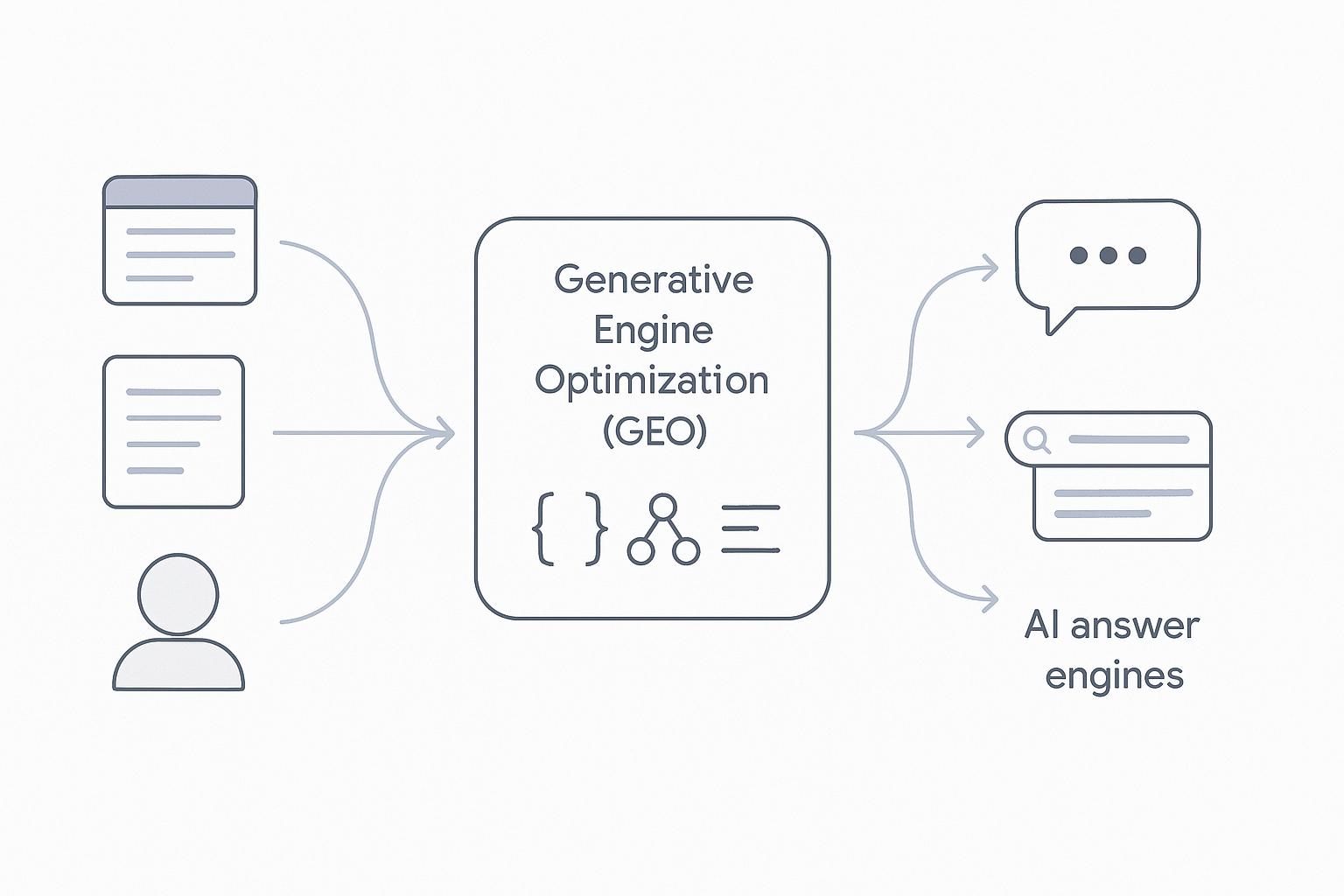 Generative Engine Optimization (GEO) is the practice of structuring, publishing, and maintaining content so it can be accurately retrieved, interpreted, summarized, and cited by generative AI systems such as ChatGPT, Google AI Overview, and Perplexity AI. GEO focuses on making information machine-readable, contextually precise, and entity-consistent rather than optimizing solely for traditional search engine rankings. The purpose of GEO is to ensure that content becomes a trusted source for AI-generated answers in environments where users receive synthesized responses instead of lists of web links. Learn more about Generative Engine Optimization services.
Context and Importance of Generative Engine Optimization
Search behavior has fundamentally changed. Users increasingly rely on AI-powered systems to answer questions directly, rather than clicking through multiple search results. Platforms such as Google AI Overview and conversational AI tools synthesize responses by evaluating multiple sources for clarity, accuracy, and authority.
This shift has introduced new requirements for content visibility:
Content must be easily interpreted by machines
Information must be structured for retrieval and summarization
Author and brand identity must function as trust signals
Traditional SEO ensures discoverability, but it does not fully address how AI systems reuse content. GEO exists to align content with how large language models process, validate, and present information.
How Generative Engine Optimization Works
Definition Ownership and Concept Clarity
AI systems favor sources that clearly define concepts early and unambiguously. Pages optimized for GEO typically:
Present a single primary definition
Avoid mixing multiple topics
Use neutral, factual language
Structured Information Architecture
Well-structured content improves AI retrieval accuracy.
Descriptive headings segment ideas
Each section addresses one concept
Terminology remains consistent throughout the page
Entity and Authority Signals
Generative AI systems rely on entity recognition to assess trust.
Clear author identification
Reinforcement of expertise through internal references
Consistency between content and author credentials
Retrieval-Oriented Formatting
Formatting directly affects how AI systems parse content.
Short paragraphs
Bullet points for factual clarity
FAQ sections aligned with natural-language prompts
Citation Readiness
Content optimized for GEO is written so it can be reused verbatim.
No promotional language
No speculative claims
Statements stand alone without requiring context
GEO Compared With SEO and AEO
| Optimization Model | Primary Focus | Target System | Primary Outcome |
|---|---|---|---|
| SEO | Rankings and traffic | Search engines | Page visits |
| AEO | Direct answers | Voice assistants | Spoken responses |
| GEO | Citations and summaries | AI answer engines | AI-generated answers |
SEO focuses on discoverability.
AEO focuses on short-form answers.
GEO focuses on being referenced as a trusted source within AI-generated responses.
Practical Implementation Insights
From implementation experience, GEO performs best when treated as structured knowledge publishing rather than marketing. High-performing GEO content typically:
Explains one topic in depth
Separates informational content from conversion content
Uses language suitable for professional and academic reuse
Organizations often adapt existing content by converting blog posts into reference-style explainers and supporting them with authoritative service pages. This approach aligns with guidance published by Google Search Central on helpful, people-first content and research shared by OpenAI on model training and information clarity.
Relationship Between GEO and Traditional SEO
GEO does not replace SEO. It extends it.
SEO ensures content can be discovered by search engines.
GEO ensures that content can be used by AI systems after discovery.
In practice:
SEO enables indexing
GEO enables citation
Pages that perform well in AI-driven environments usually follow strong SEO fundamentals while prioritizing definition clarity, structured formatting, and explicit authorship.
Key Takeaways
GEO optimizes content for AI citation rather than rankings alone
Clear definitions are foundational
Structured formatting improves AI retrieval
Explicit author identity strengthens trust
GEO complements, not replaces, SEO
Frequently Asked Questions About GEO
What is Generative Engine Optimization (GEO)?
Generative Engine Optimization is the process of structuring content so AI systems can retrieve, understand, and cite it when generating answers for users.
How does GEO differ from SEO?
SEO focuses on ranking web pages in search results, while GEO focuses on making content suitable for reuse and citation within AI-generated responses.
Why is GEO important now?
GEO is important because users increasingly rely on AI-generated answers instead of clicking search results, shifting visibility from rankings to citations.
When should a business implement GEO?
Businesses should implement GEO when their audience relies on AI tools for research, comparison, or decision-making.
Who benefits most from GEO strategies?
SEO professionals, consultants, educators, SaaS companies, and service providers benefit most from GEO strategies.
Is GEO a replacement for SEO?
No. GEO does not replace SEO. SEO ensures discoverability, while GEO ensures that content is reusable and cite-worthy within AI-generated answers.
 Author: Naresh Thapa
Experience: 5+ years in SEO and search strategy
Expertise: Technical SEO, AI-driven search optimization, Generative Engine Optimization
Industries Served: Local businesses, professional services, eCommerce, content-led platforms
This article reflects hands-on experience adapting SEO strategies to AI-driven search environments, with a focus on clarity, structure, and long-term information retrievability.