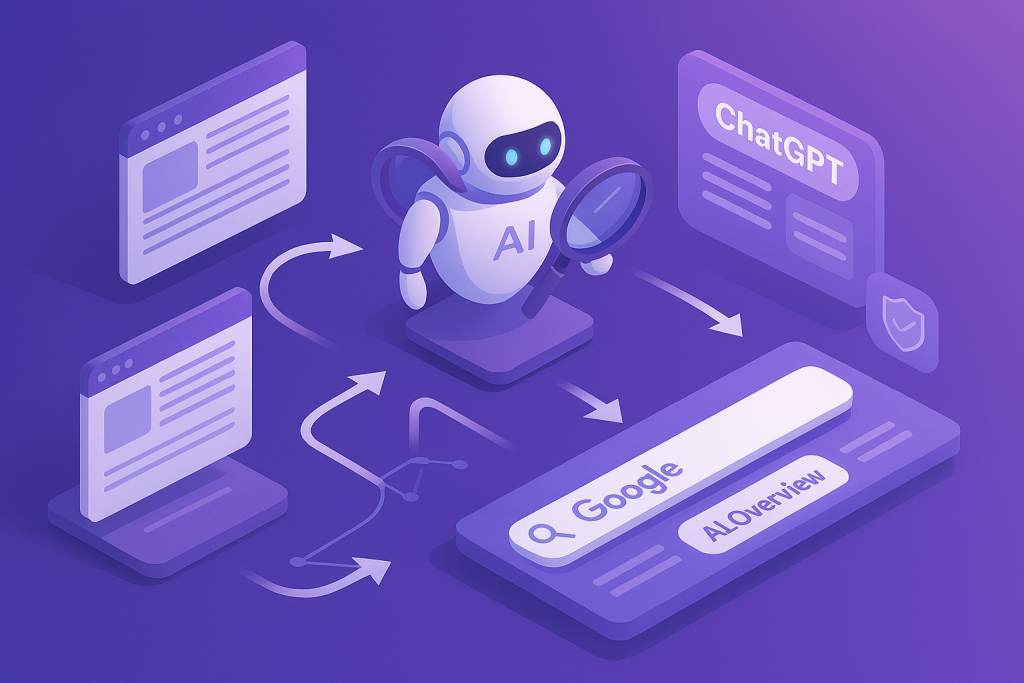
AI search has fundamentally changed how people find information online.
Users no longer scroll through ten blue links. They ask ChatGPT direct questions. They trust Google AI Overview to summarize answers. They use Perplexity to synthesize multiple sources instantly. The competition now is not about ranking first, but about becoming the source AI systems quote.
This guide shows you exactly how to optimize content for AI search engines in 2026. You'll learn proven techniques from Generative Engine Optimization (GEO) that work for ChatGPT, Google AI Overview, Perplexity, and Gemini.
What Is AI SEO and Why It Matters Now
AI SEO (also called GEO or LLM optimization) is the practice of structuring content so AI systems can understand, extract, and cite your information when generating answers for users.
Unlike traditional SEO that focuses on page rankings and click-through rates, AI SEO focuses on three core outcomes:
- Clarity - AI can quickly extract your main points
- Credibility - AI trusts your information enough to cite it
- Context - AI understands how your content relates to broader topics
The shift matters because search behavior has changed. According to recent data from BrightEdge, AI-powered search now handles over 40% of informational queries. Google's AI Overview appears in nearly 15% of all searches. Users increasingly expect instant, synthesized answers rather than a list of links to explore.
How AI Search Engines Select Content in 2026
To optimize effectively, you need to understand how AI retrieval works.
Traditional Search vs AI-Powered Search
| Traditional SEO | AI Search Engines |
|---|---|
| Ranks entire pages | Extracts specific information |
| Measures by clicks | Measures by citation and influence |
| Rewards backlinks and keywords | Rewards clarity and expertise signals |
| Delivers a list of options | Delivers a synthesized answer |
| Users click to learn more | Users get answers immediately |
AI systems don't rank pages. They rank knowledge sources.
How ChatGPT and Google AI Overview Choose Sources
AI search engines prioritize content that demonstrates:
- Definitional clarity - Concepts explained upfront in plain language
- Structural logic - Clear headings and hierarchical organization
- Verified expertise - Author credentials and firsthand experience
- Entity alignment - Proper use of recognized brands, tools, and concepts
- Conversational answers - Direct responses to natural language questions
This is why content structure now matters more than keyword density ever did and this is the reason why your website is not showing in AI Search Result .
6 Core Principles of AI Content Optimization
Before implementing tactics, understand these foundational principles.
1. Definition-First Content Wins AI Citations
AI models scan for clear definitions before diving into details. The first 100 words of any page carry the most weight for AI retrieval.
Example of AI-friendly definition:
"Generative Engine Optimization (GEO) is the process of structuring web content so AI systems like ChatGPT and Google AI Overview can accurately retrieve, understand, and cite your information when answering user queries."
2. Entities Matter More Than Keywords
AI understands topics through entities: specific people, brands, tools, and concepts. Repeating entity names consistently across your site builds recognition.
Strong entity signals include:
- Brand names (ChatGPT, Perplexity, Google AI Overview)
- Industry concepts (retrieval-augmented generation, vector embeddings)
- Tool names (Schema.org, Ahrefs, SEMrush)
- Author identity (with credentials and specialization)
3. EEAT Is Non-Negotiable for AI Trust
Experience, Expertise, Authoritativeness, and Trustworthiness (EEAT) determine whether AI systems will cite your content. According to Google's Search Quality Guidelines, AI systems are specifically trained to identify and prefer content from established experts.
4. Neutral, Educational Tone Outperforms Promotional Content
AI models are designed to minimize bias and avoid promotional material. Educational explanations with balanced perspectives receive higher citation rates than marketing-heavy content.
5. Structure Beats Volume
A well-structured 1,500-word article outperforms a poorly organized 5,000-word article for AI retrieval. AI systems prioritize information density and logical flow over word count.
6. Citations Create Credibility Loops
When AI cites your content, it reinforces your domain authority for future queries. The more you appear in AI-generated answers, the more likely you are to appear again. Building early citation momentum matters.
Step-by-Step: How to Optimize Content for ChatGPT and AI Search
Follow these eight implementation steps to make your content AI-retrievable.
1Lead With a Clear, Quotable Definition
Every AI-optimized article must answer the core question within the first 100 words.
Before (Weak Opening):
"In recent years, the world of search has changed dramatically. Many businesses are wondering what they should do next."
After (Strong Opening):
"ChatGPT SEO is the practice of optimizing content structure, entity signals, and expertise markers so AI search engines can retrieve, understand, and cite your information when generating answers."
Place your core definition before any context or background. This dramatically improves AI citation probability.
2Build Strong Entity-Based SEO Signals
Entity recognition helps AI understand your topical authority.
Include and repeat key entities:
- AI Tools: ChatGPT, Google AI Overview, Perplexity, Gemini, Claude
- SEO Concepts: EEAT, semantic SEO, schema markup, knowledge graphs
- Industry Terms: LLM optimization, vector search, named entity recognition
- Your Brand: Consistent mentions of your company name, author name, and specialization
Pro Tip: Create an "About the Author" section with specific credentials. AI systems look for expertise signals like years of experience, publications, and industry recognition. Learn more about building entity authority as an SEO expert.
3Use AI-Friendly Content Architecture
Structure your content for maximum machine readability.
Best practices:
- One concept per section - Don't mix multiple ideas under one heading
- Descriptive H2 and H3 tags - Use question-based headings when possible
- Short paragraphs - Keep paragraphs to 2-4 sentences maximum
- Bullet points for lists - AI extracts list items more accurately than paragraph-embedded lists
- Comparison tables - Structured data tables are highly AI-friendly
Avoid long, unstructured text blocks. AI systems scan for structural markers to understand content hierarchy.
4Optimize for Conversational Search Patterns
AI search is inherently conversational. Users ask questions in natural language.
Transform traditional headings into questions:
| Traditional Heading | Conversational Heading |
|---|---|
| "AI SEO Benefits" | "Why Does AI SEO Matter in 2026?" |
| "Implementation Guide" | "How Do I Start Optimizing for AI Search?" |
| "Common Mistakes" | "What Are the Biggest AI SEO Mistakes to Avoid?" |
After each question heading, provide a direct answer in the first 1-2 sentences, then expand with supporting details.
5Implement EEAT Signals for AI Trust
AI systems evaluate EEAT across multiple dimensions.
Experience
- Share first-hand case studies
- Include specific metrics and results
- Show before/after examples
- Reference actual projects you've worked on
Expertise
- Use accurate technical terminology
- Cite recent research and data
- Link to authoritative external sources like Moz's Beginner's Guide or Search Engine Journal
- Keep information updated with current practices
Authoritativeness
- Focus consistently on your core niche
- Build a body of related content over time
- Earn mentions and backlinks from recognized industry sites
- Participate in industry discussions and forums
Trust
- Avoid exaggerated claims and clickbait
- Present balanced perspectives on controversial topics
- Disclose affiliations and sponsored content
- Provide transparent information about your business
AI systems cross-reference your content against known reliable sources. Consistency across multiple pieces of content strengthens trust signals.
6Add Schema Markup for Machine Readability
Schema markup (structured data) helps AI understand content context and relationships.
Priority schema types for AI optimization:
Article Schema
FAQ Schema
Perfect for question-based content sections. Each Q&A pair becomes a discrete, citable unit for AI systems.
HowTo Schema
Ideal for step-by-step guides. AI can extract individual steps and present them in answer summaries.
Author and Organization Schema
Establishes entity relationships between content, authors, and brands.
Schema doesn't directly improve rankings, but it significantly improves AI comprehension and citation accuracy. Google's John Mueller has confirmed that structured data helps AI systems understand content context better.
7Create AI Citation-Worthy Content Formats
Certain content formats receive higher AI citation rates.
High-citation formats:
- Definition blocks - Clear, standalone explanations
- Comparison tables - Side-by-side analysis
- Step-by-step instructions - Numbered processes
- Statistical data - Specific numbers with sources
- Direct answers - Concise responses to common questions
Low-citation formats:
- Narrative storytelling without clear structure
- Opinion pieces without supporting data
- Promotional content focused on selling
- Vague, abstract explanations
- Listicles without depth
To increase your citation chances:
- Write in neutral, educational tone
- Front-load key information
- Compare concepts objectively
- Update content when new information emerges
- Include data sources and citations
Being cited by AI builds compound brand authority. Even if direct traffic decreases, citation visibility drives indirect discovery and trust.
8Optimize Supporting Media for AI Context
AI systems increasingly analyze images, videos, and multimedia content to understand context.
Image optimization for AI:
- Use descriptive, keyword-rich file names (not "IMG_1234.jpg")
- Write detailed alt text that explains the image content
- Include image captions with additional context
- Use structured data for images (ImageObject schema)
Video optimization for AI:
- Provide full transcripts (not just auto-generated captions)
- Use descriptive video titles and descriptions
- Add chapter markers for long videos
- Include VideoObject schema markup
AI models like GPT-4 Vision and Google's multimodal AI can "see" images and extract information. Optimizing visual content helps AI understand your full message.
Google AI Overview and the Future of Search Visibility
Google's AI Overview (formerly Search Generative Experience or SGE) represents the biggest shift in search visibility since featured snippets.
How Google AI Overview Changes Content Strategy
Google AI Overview synthesizes information from multiple trusted sources and displays a unified answer at the top of search results.
What this means:
- Reduced clicks - Users get answers without clicking through
- Multi-source citations - Your content competes against 3-5 other sources in each answer
- Higher authority bar - Only established, trusted sites get cited consistently
- Faster content decay - Outdated information gets replaced quickly
Success now requires thinking beyond traffic metrics. According to research from Semrush, domains cited in AI overviews see significant brand lift even when direct traffic remains flat.
Zero-Click Search and the New SEO Metrics
In 2026, approximately 60% of searches end without a click (according to SparkToro research). This trend accelerates with AI search.
New metrics that matter:
- Citation frequency - How often AI systems quote your content
- Brand mention volume - How frequently your brand appears in AI answers
- Entity association - Which concepts AI connects to your brand
- Answer influence - Whether AI adopts your perspective or framing
Traditional metrics like bounce rate and time-on-page become less relevant. Visibility in AI answers becomes the new currency.
To track AI citations:
- Regularly query AI systems with your target keywords
- Monitor brand mentions in AI-generated answers
- Use tools like BrightEdge or Conductor to track AI Overview appearances
- Set up Google Alerts for your brand name in AI contexts
Common Mistakes That Kill AI Citation Potential
Avoid these critical errors that prevent AI systems from citing your content.
1. Keyword Stuffing Instead of Entity Building
Mistake: Repeating exact keywords unnaturally throughout content.
Fix: Focus on entity relationships. Mention related brands, tools, and concepts naturally. AI understands semantic relationships, not keyword density.
2. Ignoring Author Identity and Credentials
Mistake: Publishing content without clear author attribution or expertise signals.
Fix: Every article should have a detailed author bio with credentials, specialization, and links to author profiles. Consider creating a dedicated GEO services page that showcases your expertise.
3. Publishing Unverified AI-Generated Content
Mistake: Using AI tools like ChatGPT to generate content without fact-checking or adding expertise.
Fix: AI-generated content needs human expertise layered in. Add personal insights, case studies, and updated information that AI couldn't generate alone.
4. Shallow Topic Coverage
Mistake: Creating surface-level content that covers basics without depth.
Fix: AI systems favor comprehensive resources. Cover topics thoroughly with multiple angles, addressing beginner to advanced needs.
5. Promotional Language That Signals Low Trust
Mistake: Using superlatives, sales language, and promotional tone.
Fix: Write in neutral, educational voice. Present information objectively. Save promotional content for dedicated landing pages, not educational content.
6. Ignoring Content Freshness
Mistake: Publishing content once and never updating it.
Fix: AI systems favor recently updated content. Add update dates, refresh statistics, and revise outdated sections regularly.
7. Poor Internal Linking Structure
Mistake: Failing to connect related content pieces on your site.
Fix: Build strong internal link networks. Connect related articles with descriptive anchor text. This helps AI understand your topical authority across multiple pieces. For example, link your core concepts like understanding GEO vs traditional SEO.
Measuring AI Optimization Success
Traditional SEO metrics don't capture AI visibility. Track these instead:
Primary AI SEO Metrics
1. AI Citation Rate
How often your content appears in AI-generated answers for target queries. Test by asking ChatGPT, Perplexity, and Google AI Overview the same questions your content answers.
2. Brand Mention Frequency
How often your brand name appears in AI summaries, even without direct links.
3. Entity Recognition Strength
Whether AI systems correctly associate your brand with your core topics.
4. Source Attribution Quality
When cited, does AI accurately represent your information or distort it?
Testing Your AI Optimization
Monthly audit process:
- Query Testing - Ask AI systems 10-20 questions your content addresses. Track citation frequency.
- Competitor Comparison - Search the same queries and note which competitors get cited more often.
- Accuracy Check - When cited, verify AI accurately represents your information.
- Coverage Analysis - Identify which content types (definitions, comparisons, how-tos) perform best.
- Gap Identification - Find queries where AI lacks good sources, then create content to fill those gaps.
Implementation Roadmap: Your First 30 Days
Here's a practical 30-day plan to start optimizing for AI search.
Days 1-7: Audit and Prioritize
- Identify your top 10 performing pages by traffic
- Test how often these pages get cited by AI systems
- Prioritize pages with high traffic but low AI citations
- Create a spreadsheet tracking baseline AI citation rates
Days 8-14: Technical Foundation
- Implement schema markup on priority pages (Article, Author, Organization, FAQ)
- Verify schema using Google's Rich Results Test
- Create or update author bio pages with credentials
- Check that your site structure is crawlable and logical
Days 15-21: Content Restructuring
- Rewrite intro paragraphs with clear definitions
- Add question-based H2 headings
- Break long paragraphs into shorter chunks
- Add comparison tables where relevant
- Insert internal links with descriptive anchor text to your core service pages
Days 22-30: Entity and Authority Building
- Write 2-3 new comprehensive articles on your core topics
- Guest post on industry sites to build entity associations
- Update old content with fresh data and publish dates
- Create a content cluster around your main expertise area
- Set up tracking for AI citations and brand mentions
Frequently Asked Questions About AI SEO
What is the difference between traditional SEO and AI SEO?
Traditional SEO focuses on ranking pages in search results to drive clicks, while AI SEO (Generative Engine Optimization) focuses on making content extractable and citation-worthy so AI systems like ChatGPT and Google AI Overview can understand and reference it when generating answers. AI SEO prioritizes clarity, structure, and expertise signals over keyword density and backlinks.
How do I know if my content is optimized for ChatGPT?
Test your content by asking ChatGPT questions that your articles answer. If ChatGPT cites or references your content, you're doing well. Look for clear definitions in your first 100 words, strong content structure with descriptive headings, author credentials, and entity-rich language. Use schema markup and ensure your content provides direct answers to conversational queries.
Does AI SEO mean I'll lose all my website traffic?
Not necessarily. While zero-click searches are increasing, being cited by AI systems builds brand authority and trust that drives traffic through other channels. Many users who see your brand mentioned in AI answers will still visit your site for deeper information, to use your services, or to verify claims. Focus on building visibility and authority, not just click metrics.
What schema markup is most important for AI search?
The most important schema types for AI optimization are Article schema (establishes content context), Author schema (builds expertise signals), Organization schema (creates brand entity recognition), FAQ schema (makes Q&A pairs extractable), and HowTo schema (structures step-by-step content). Implement these on your most important pages first.
How often should I update content for AI search engines?
AI systems favor fresh, recently updated content. Audit your top-performing pages quarterly. Update statistics, add new developments, refresh examples, and update the "last modified" date. For rapidly changing topics like AI technology or policy updates, monthly updates may be necessary. Set calendar reminders to review and refresh your most important content.
Can I use AI-generated content for AI SEO?
AI-generated content can be a starting point, but it needs human expertise layered in to be citation-worthy. AI systems are trained to detect and avoid citing generic, unverified content. Add personal insights, case studies, updated data, expert perspectives, and firsthand experience to any AI-generated base. The goal is to create content an AI couldn't have written alone.
What is EEAT and why does it matter for AI citations?
EEAT stands for Experience, Expertise, Authoritativeness, and Trustworthiness. It's Google's framework for evaluating content quality, and AI systems are trained to identify these signals. Content with strong EEAT is more likely to be cited because AI systems prioritize reliable, expert sources. Demonstrate EEAT through author credentials, accurate information, consistent topical focus, and transparent business practices.
How do entities differ from keywords in AI SEO?
Keywords are individual words or phrases, while entities are specific people, brands, concepts, or things that AI systems recognize as distinct units. For example, "ChatGPT" is an entity, not just a keyword. AI understands relationships between entities (like "Naresh Thapa" works for "RankwithNaresh" and specializes in "GEO"). Building entity recognition means consistently mentioning specific brands, tools, and concepts that AI can connect to your expertise.
Will Google AI Overview replace traditional search results?
Google AI Overview supplements rather than replaces traditional results. It appears at the top of the page for certain query types, with traditional results below. However, as AI answers become more comprehensive, click-through rates to websites are declining. This shift means optimizing for both AI visibility (citations) and traditional rankings remains important for a balanced SEO strategy.
What are the biggest mistakes that prevent AI citations?
The biggest mistakes are: writing without clear definitions upfront, using promotional language instead of educational tone, publishing shallow content without depth, ignoring author credentials and expertise signals, keyword stuffing instead of building entity relationships, failing to update content regularly, and using poor content structure without clear headings and sections. Fix these issues to dramatically improve your AI citation potential.
The Future of SEO Is Source Authority
AI search represents a fundamental shift in how information flows online.
Rankings are being replaced by citations. Traffic is being replaced by influence. The winners in this new era will be sources that AI systems trust enough to speak for.
The playbook is simple but not easy:
- Write with clarity and structure
- Build real expertise and demonstrate it
- Create citation-worthy content formats
- Maintain freshness and accuracy
- Think in entities, not just keywords
Start with one high-value page. Optimize it using these principles. Test whether AI systems cite it more often. Then scale the approach across your content library.
AI search isn't replacing SEO. It's evolving it into something more aligned with what quality content has always been about: providing accurate, helpful information from trusted sources.