
Is SEO still worth pursuing as a career in 2026 or has AI already taken over the game?
Yes, SEO is an excellent career choice in 2026, but it now comes with more challenges and opportunities because of the massive evolution of AI in today’s digital world. And if you’re reading this from Nepal or any emerging market, you’re actually in a better position than you might think.
Fast-forward to 2026,The tools have changed, The algorithms have evolved, Google now has AI Overviews and AI mode. AI like ChatGPT, Gemini, Perplexity and many more has evolved and make their presence effectively in this market so now you need to be an SEO & AI Optimization Expert to rule this market.
But that core truth? Still the same. Every business needs visibility but the difference is they just don’t only want to rank in serf but also need to get feature in AI chatbots as well, and someone has to make that happen both in google and AI chats.
So still the reliability of SEO exist but has more challenge and opportunities due to the massive evolve of AI chatbots in this digital market.
In this article, I’ll show you why SEO remains one of the smartest career moves you can make right now still in 2026 as an SEO Expert consultant. I’ll share real salary numbers, the skills that actually matter, what the job market looks like globally and country like Nepal, and how to build a career in SEO in Nepal that grows along with you.
Quick Answer: What is SEO in 2026?
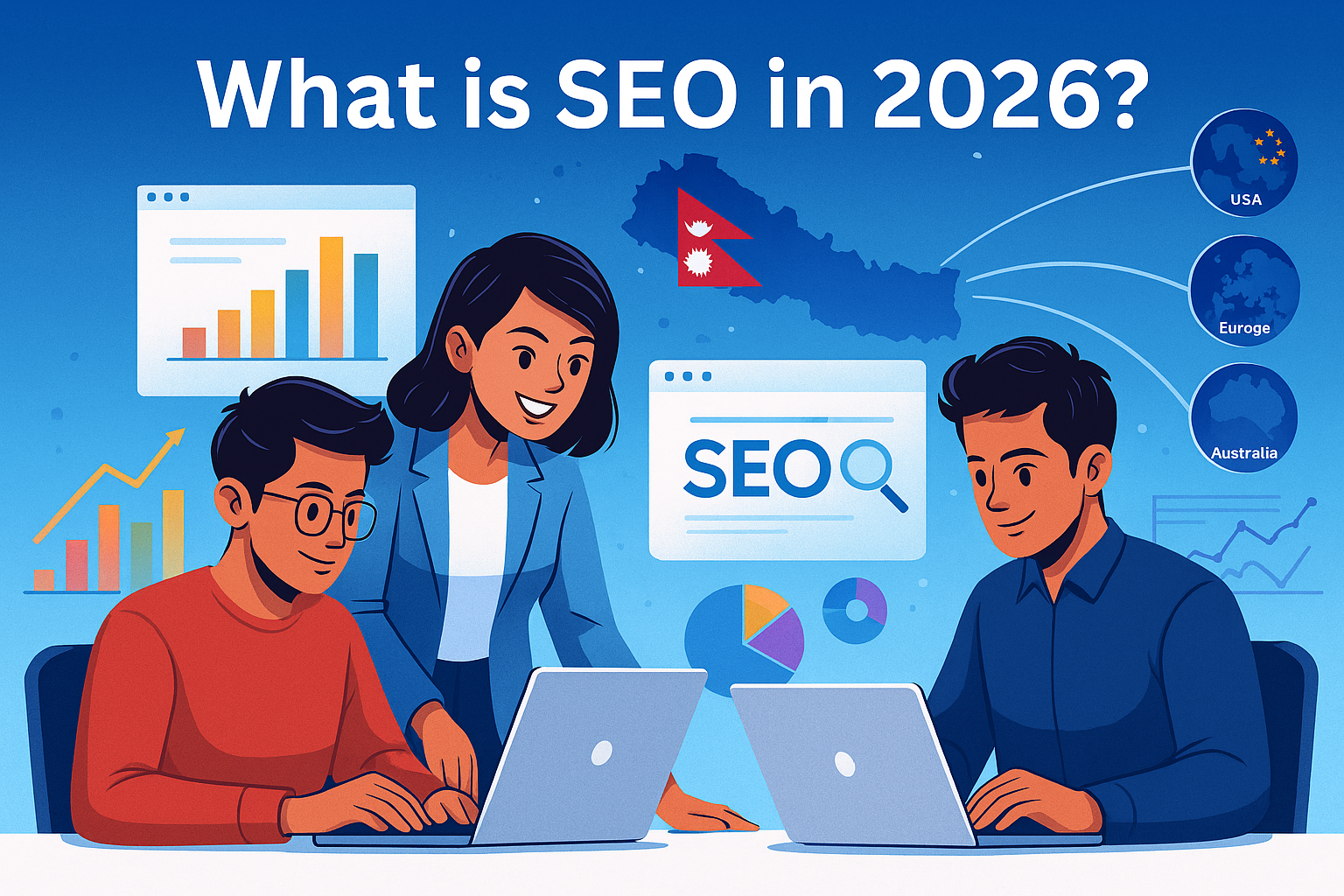 Search Engine Optimization in 2026 isn’t just about stuffing keywords and building backlinks anymore. It’s about making your brand discoverable across every platform where people search-Google, YouTube, ChatGPT, Perplexity, even social media like facebook & TikTok.
Modern SEO combines:
- Content strategy that demonstrates real expertise
- Technical optimization (site speed, mobile experience, Core Web Vitals)
- Data analytics to prove what’s working
- AI-powered search optimization (AEO/GEO) so your content gets cited by AI chatbots
- User experience signals that keep people on your site
If you can master this blend, you’re not just an “SEO person.” You’re a digital visibility strategist and businesses will pay well for that.
5 Reasons Why SEO is a Great Career in 2026
1. The Industry is Growing (Not Dying)
Let me address the elephant in the room first. Every year since 2010, someone declares “SEO is dead.” Every year, they’re wrong.
The numbers tell a different story. The global SEO services market hit $68.27 billion in 2022 and is projected to reach $170 billion by 2028,that’s a compound annual growth rate of 18.3%.
Job interest backs this up. Search volume for “SEO jobs” has stayed consistently strong, with interest scores above 60 out of 100 even through economic uncertainty.
What this means for you: You’re entering a growing field, not a dying one. The demand is there. The money is there. You just need the desired skills to rule this digital market organically.Discover the highest earning digital marketing career paths to watch in 2026 and plan your growth with this comprehensive guide.
You are living in Biratnagar and probably Local SEO for Dental clinic might be opportunity for you.
2. Less Commodity Work, More Strategic Thinking
Here’s what I love about SEO in 2026 compared to when I started in 2020: the boring stuff is getting automated.
AI tools now handle:
- Basic keyword research
- Meta description writing
- Content outline generation
- Technical audits (to an extent)
- and many more
What can’t be automated? Strategy. Understanding why a business needs to rank for certain keywords. Knowing how to balance user intent with business goals. Analyzing what competitors are doing and finding the gaps.
According to the 2025 State of SEO Jobs report, demand for technical SEO skills, data analytics, and UX expertise has jumped 40% year-over-year. These are high-value skills that command premium salaries.
Translation: If you position yourself as a strategic thinker (not just a task executor), you’ll always be in demand. If you are working for Local SEO for any private Hospital you need to have specific Hospital SEO strategy.
3. Work From Anywhere, Serve Anyone
This is huge, especially if you’re in Nepal.
In 2019, I had a client ask me, “Can you really do SEO from Kathmandu?” Today, that question sounds absurd. I’ve worked with clients in Australia, the UK, and the US all from my home office in koshi Province.
SEO is one of the few careers where:
- Your physical location doesn’t matter
- You can charge international rates
- You can serve local businesses or global enterprises
- Remote work is the norm, not the exception
For Nepal specifically, this creates a massive arbitrage opportunity. You can charge $50-100/hour to international clients while your cost of living stays low. I have friends doing exactly this, making $1500-$2500 USD per month while living comfortably in Kathmandu. If you want to learn how to become one of the best SEO Expert from Nepal you can go through this blog post to learn step by step process to become such expertise in this field.
4. Multiple Income Streams
Unlike most 9 to 5 jobs, SEO lets you diversify your income:
| Income Stream | Time to Start | Monthly Potential (Nepal) | Best For |
|---|---|---|---|
| In-house SEO job | 0-6 months | NPR 25K-100K | Beginners needing stability |
| Freelance consulting | 6-18 months | $500-$2000 USD | Self-starters |
| SEO agency | 2-4 years | $2,000-$5,000+ USD | Entrepreneurs |
| Affiliate sites | 1-3 years | $100-$5,000+ USD | Patient investors |
| Online courses/coaching | 3-5 years | $500-$5,000+ USD | Teachers |
I personally do a mix of consulting (60% of income), affiliate sites (30%), and occasional training workshops (10%).
5. No Degree Required (Just Proof of Skills)
I don’t have a computer science degree. I studied Finance Account management that didn’t even teach digital marketing. Most successful SEO I know come from random backgrounds journalism, teaching, even drop off from college.
What matters? Your ability to show results.
When I hire SEO professionals, I never ask for their degree. I ask:
- “Show me a site you’ve ranked.”
- “Walk me through how you’d approach this technical issue.”
- “What’s the last SEO experiment you ran?”
If you want to hire Seo agency ask them this questions before you get a right SEO expert for you.
If you can demonstrate real skills, nobody cares where (or if) you went to university.
Is SEO Still in Demand in 2026?
Yes—but the type of SEO work in demand has changed.
Basic tasks like “write 10 blog posts with keywords” or “build 50 backlinks” are being commoditized. These jobs are either automated or outsourced to cheap labor markets.
What’s growing:
- Technical SEO specialists who understand JavaScript rendering, Core Web Vitals, structured data
- Analytics-driven SEO who can prove ROI and run experiments
- Content strategists who understand E-E-A-T (Experience, Expertise, Authoritativeness, Trustworthiness)
- AI search optimizers who know how to get content featured in ChatGPT, Perplexity, and Google AI Overviews
A 2025 Backlinko survey found that 91% of marketers still say SEO works well for their business. Companies aren’t cutting SEO budgets, they’re just getting pickier about who they hire.
What Skills Do You Actually Need in 2026?
Let me break this down into three tiers, based on where you are in your career:
Foundation Skills (Months 0-12)
Learn these first:
- On-page SEO (title tags, headers, meta descriptions, internal linking)
- Keyword research using free tools (Google Keyword Planner, AnswerThePublic)
- Content optimization (writing for humans first, search engines second)
- Basic WordPress/CMS management
- Google Search Console and Google Analytics 4 basics
Free resources to start today:
Time investment: 2-3 hours daily for 3-6 months.
Intermediate Skills (Months 12-24)
Level up with:
- Technical SEO (site speed, mobile optimization, crawlability, Core Web Vitals)
- Data analysis (GA4 custom reports, Search Console deep-dives)
- Link building strategies (digital PR, guest posting, broken link building)
- Competitive analysis using tools like Semrush or Ahrefs
- Basic HTML/CSS (you don’t need to be a developer, but understanding code helps)
Paid tools worth investing in:
- Semrush or Ahrefs (start with free trials)
- Screaming Frog (free up to 500 URLs)
- Google Tag Manager
Nepal context: At this stage, you can start taking on small local clients. Charge NPR 15,000-30,000/month for basic SEO services while you build your portfolio.
Advanced Skills (Months 24-48)
Specialize in:
- Enterprise-level SEO (handling sites with 10,000+ pages)
- AI-powered search optimization (getting cited in ChatGPT, Perplexity)
- Python for SEO automation (optional but powerful)
- Migration projects (HTTP to HTTPS, platform changes)
- International/multilingual SEO
At this level: You’re charging $1,500-5,000+ USD per month per client, or holding senior in-house positions with equity/bonuses.
What Does an SEO Actually Do Day-to-Day?
People always ask me, “What does your workday look like?” Here’s a real snapshot from last Tuesday:
9:00 AM – Black Tes, check email, review overnight algorithm tracking. Google pushed a small update. Minor fluctuations in rankings—nothing alarming.
9:30 AM – Open Google Search Console for three client sites. One has indexing issues (404 errors from old URLs). Create redirects.
10:30 AM – Competitor backlink analysis for an e-commerce client. Discovered they’re getting links from industry forums we haven’t targeted. Note for outreach.
11:30 AM – Content review. A writer submitted a 2,000-word article on “best trekking boots.” It’s… okay. I add more first-hand experience, restructure headers for better scannability, optimize for featured snippets.
1:00 PM – Lunch break. (In Kathmandu, this means dal bhat if I’m being traditional, or a quick momo fix.)
2:00 PM – Client Zoom call. “Why did our rankings drop last week?” I explain Google’s helpful content update, show them that their traffic is actually stable (just rankings shifted), and discuss content improvements.
3:30 PM – Keyword research for a new client in the finance sector. Building a content calendar for the next quarter.
5:00 PM – Learning time. I read three SEO newsletters (Search Engine Land, Marie Haynes, Lily Ray), watch a YouTube video on Google’s Search Generative Experience updates.
6:00 PM – Wrap up, plan tomorrow’s priorities.
Some days are more technical (fixing site speed issues, implementing schema markup). Other days are more strategic (presenting quarterly reports, planning content strategy). The variety is what keeps it interesting.
How Much Money Can You Really Make?
Let’s talk numbers. I’ll give you global benchmarks, then Nepal-specific reality.
Global SEO Salaries (2026)
| Position | Average Salary (USD) | Range |
|---|---|---|
| SEO Specialist | $65,000/year | $50K-$95K |
| SEO Manager | $85,000/year | $65K-$120K |
| SEO Director | $120,000/year | $90K-$180K |
| Freelance/Consultant | $75-150/hour | Varies widely |
Source: Glassdoor, Indeed, ZipRecruiter averages for US market, 2025
Nepal SEO Income Reality
Here’s what you can realistically expect in Nepal (based on conversations with 20+ SEO professionals in Nepal):
Entry-Level (0-2 years experience):
- Local agency/in-house: NPR 25,000-50,000/month
- Freelance (local clients): NPR 15,000-40,000/month per client
- Remote work (international): $200-500/month (rare at this level)
Mid-Level (2-5 years experience):
- Senior agency role: NPR 60,000-120,000/month
- Freelance (mixed clients): NPR 80,000-200,000/month
- Remote work (international): $800-2,500/month
Senior/Expert (5+ years):
- Agency leadership: NPR 150,000-300,000/month
- Freelance consultant: $2,000-6,000/month USD
- Agency owner: $3,000-15,000+/month USD (highly variable)
Real example: I know an SEO in Pokhara who works 30 hours/week for three US clients at $75/hour. That’s $9,000 USD/month. His living costs in Pokhara? About $300/month. That kind of lifestyle arbitrage is possible with SEO in a way few other careers offer.
Is SEO Right for Your Personality?
Skills can be learned. But if these traits don’t describe you, SEO might be frustrating:
You’ll thrive in SEO if you:
✓ Love solving puzzles that keep changing Google updates its algorithm 500-600 times per year. Most are tiny. Some are massive. If you get frustrated by change, this career will drive you crazy.
✓ Can handle delayed gratification SEO takes 3-6 months minimum to show results. Sometimes longer. You can do everything right and still wait months to see rankings move. If you need instant wins, consider PPC instead.
✓ Enjoy working with data You’ll spend hours in Google Analytics, Search Console, and various tracking tools. If numbers make your eyes glaze over, you’ll struggle.
✓ Are comfortable working independently Especially in Nepal, you won’t have a mentor at the next desk. You’ll teach yourself a lot through blogs, YouTube, and trial-and-error.
✓ Like helping people (indirectly) At its core, SEO is about connecting people with information they need. If that doesn’t motivate you, the technical stuff will feel meaningless.
You might struggle if you:
✗ Need immediate feedback SEO is a long game ✗ Hate sitting at a computer 80% of SEO work is desk-based ✗ Don’t like ambiguity ,Google doesn’t publish exact ranking factors ✗ Aren’t self-motivated Especially as a freelancer, nobody’s watching over your shoulder
Common Fears (And Why They’re Wrong)
“Will AI replace SEO jobs!”
I hear this constantly. Here’s the truth: AI is changing SEO, not killing it.
Yes, AI can write content now. But it can’t:
- Understand a business’s unique positioning
- Analyze why a specific strategy failed
- Build relationships for link building
- Interprete data and recommend strategic pivots
- Stay updated with algorithm changes and adapt them
In fact, search interest for “AI SEO services” is rising. Businesses need SEO who understand how to leverage AI tools & optimize for AI-powered search engines like ChatGPT and Perplexity.
The SEOs who’ll thrive: Those who use AI to automate the work and focus on strategy.
The SEOs who’ll struggle: Those who refuse to adapt and stick to old SEO 2015 tactics.
“I don’t have a degree in computer science”
Neither do most of us,I studied management,My best freelance colleague studied political science & another Local SEO Consultant I know was a high school teacher before switching careers to SEO at the age of 35.
What matters: Can you learn? Can you show results?
Build a portfolio site. Rank it for a competitive keyword in your city. Screenshot the results. That’s your degree.
“There are too many SEOs already”
There are also too many doctors, lawyers, and engineers. Yet skilled ones always find work.
The market isn’t saturated with GOOD SEOs, it’s saturated with mediocre ones who do the same basic tactics everyone else does.
Differentiate yourself by:
- Specializing (local SEO, e-commerce, SaaS)
- Going deep on technical skills
- Building a personal brand (blog, LinkedIn, Twitter)
- Serving a specific niche (dental practices, law firms, tourism)
“I can’t afford expensive SEO tools”
When I started in 2020, I couldn’t afford Ahrefs ($99/month felt like a fortune). I used free tools for the first 18 months:
- Google Search Console
- Google Analytics
- Google Keyword Planner
- Ubersuggest (limited free version)
- AnswerThePublic
- Screaming Frog (free up to 500 URLs)
Once I landed two clients at NPR 25,000 each, I invested in Semrush. Tools are investments, not prerequisites.
Why This Career is Perfect for Nepal (And Other Emerging Markets)
I’m biased because I live here, but let me make the case:
1. Local Market Opportunity
Most Nepali businesses are still SEO-illiterate. I’ve consulted with companies that:
- Don’t have Google My Business profiles
- Haven’t claimed their brand name on social media
- Have websites that take 15 seconds to load
- Don’t know what keywords are
This is opportunity. You can be the expert in a market that’s just waking up to SEO’s importance.
2. Global Market Access
Nepal’s timezone (GMT+5:45) overlaps partially with Europe and Asia-Pacific. You can serve clients in:
- India (massive market, similar timezone)
- Australia (only 4.5 hours ahead)
- Middle East (1-2 hours behind)
- Europe (morning overlap)
With Zoom, Slack, and modern payment systems (Wise, Payoneer), geography is irrelevant.
3. Low Competition (For Now)
Search “SEO services pokhara” right now. You’ll find maybe 20-30 agencies. Compare that to “SEO services London” (thousands).
Being an early mover in Nepal means:
- Easier to rank your own site
- Easier to build a brand
- Less competition for clients
- Opportunity to become a thought leader
4. Cost of Living Advantage
This is the big one. If you charge international rates ($50-100/hour) while living in Nepal, your lifestyle improves dramatically.
Quick math:
- 20 hours/week at $75/hour = $6,000/month
- Living costs in Kathmandu = $300-800/month
- That leaves $5000+/month for savings, investment, travel
This arbitrage is exactly why so many digital nomads flock to places like Bali, Chiang Mai, and yes, increasingly Kathmandu Nepal.
Your SEO Career Roadmap (12-48 Months)
Here’s the path I wish someone had shown me in 2020:
Months 0-6: Foundation Building
Goal: Understand SEO basics and get your first win (even if it’s your own site).
Actions:
- Take free courses (Moz, Semrush Academy, HubSpot)
- Start a niche blog (travel in Nepal, tech reviews, cooking—anything you’re interested in)
- Implement on-page SEO on your blog
- Write 10-15 articles
- Learn Google Search Console and GA4 basics
- Join SEO communities (r/SEO, SEO Facebook groups in Nepal)
Milestone: Rank your blog for at least one low-competition keyword in top 10.
Months 6-12: First Clients
Goal: Land 1-3 paying clients (even if they’re small).
Actions:
- Offer free SEO audits to local businesses
- Create case studies from your blog’s growth
- Build a simple portfolio website
- Network in local business groups
- Start at NPR 10,000-15,000/month to gain experience
- Document everything you learn
Milestone: Earn your first NPR 25,000 from SEO services.
Months 12-24: Skill Expansion
Goal: Add technical SEO and analytics depth.
Actions:
- Learn technical SEO (Core Web Vitals, JavaScript rendering, schema markup)
- Master GA4 and Google Tag Manager
- Study 2-3 case studies weekly from Search Engine Journal
- Invest in one paid tool (Semrush or Ahrefs)
- Raise your rates to NPR 25,000-40,000/month
- Start building your personal brand (LinkedIn posts, guest articles)
Milestone: Handle technical audits confidently. Have 5-7 active clients or a solid in-house role.
Months 24-36: Specialization
Goal: Become known for something specific.
Actions:
- Pick a niche: local SEO, e-commerce, SaaS, tourism, etc.
- Create in-depth guides in your specialty
- Speak at local marketing events
- Target international clients (start pitching on Upwork, LinkedIn)
- Charge $500-1,500 USD/month per client
Milestone: Be recognized as a specialist. “Oh, you need hotel SEO in Nepal? Talk to [your name].”
Months 36-48: Leadership & Scale
Goal: Build leverage through team, products, or passive income.
Actions:
- Hire junior SEOs or VAs to handle execution
- Focus on strategy and client relationships
- Create a course or coaching program
- Build affiliate sites for passive income
- Consider starting an agency
Milestone: Earn $3,000-5,000+ USD/month with systems that don’t require your constant involvement.
Free Resources to Start Your SEO Career Today
Don’t wait. Start learning tonight. Here’s your curriculum:
Week 1-2: SEO Fundamentals
- Moz Beginner’s Guide – Read the entire guide
- Google Search Central – Understand how Google works
- Ahrefs YouTube Channel – Watch beginner tutorials
Week 3-4: Keyword Research
- Google Keyword Planner – Free tool (requires Google Ads account)
- AnswerThePublic – Find question-based keywords
- Ubersuggest – Free limited searches
Month 2: Technical SEO
- PageSpeed Insights – Learn site speed basics
- Screaming Frog SEO Spider – Free up to 500 URLs
- Web.dev – Learn Core Web Vitals
Month 3: Analytics
- Google Analytics Academy – Free GA4 courses
- Google Tag Manager Course – Free video series
Ongoing Learning
- Search Engine Journal – Daily news
- Search Engine Land – Industry updates
- Marie Haynes Newsletter – Algorithm change analysis
- r/SEO on Reddit – Community discussions (take advice with skepticism)
Myths About SEO Careers (Debunked)
Myth 1: “SEO is dead because of AI”
Reality: SEO is evolving, not dying. Yes, Google now has AI Overviews. Yes, ChatGPT can answer questions. But someone still needs to optimize content to appear in those AI responses. That’s called Answer Engine Optimization (AEO), and it’s the next frontier of SEO.
A 2025 Backlinko survey found 91% of marketers still say SEO works well. The game is changing, not ending.
Myth 2: “It’s just repetitive link building”
Reality: If your SEO career is just link building, you’re doing it wrong. Modern SEO involves:
- Technical architecture
- Content strategy
- Data analysis
- Conversion optimization
- AI search optimization
The 2025 State of SEO Jobs report shows technical skills and analytics are the fastest-growing requirements. Repetitive tasks are being automated.
Myth 3: “You can’t make good money unless you’re in the US”
Reality: I know SEOs in Nepal earning $5,000+ USD/month. Location matters less than skill and positioning.
The trick? Serve international clients remotely. A business in Sydney doesn’t care if you’re in Kathmandu as long as you deliver results.
Myth 4: “You need to be on page 1 within weeks”
Reality: Anyone promising “page 1 in 30 days” is probably using black-hat tactics that’ll get you penalized. Quality SEO takes 3-6 months minimum for competitive keywords.
Set realistic expectations with clients. The good ones understand this. The bad ones aren’t worth working with anyway.
Final Thoughts: Is This Career Worth It?
Five years ago, I took a chance on an industry I barely understood. I earned NPR 18,000 in my first 6 month (barely enough to cover rent and dal bhat).
Today, I work from my home office in Biratnagar,Nepal, set my own hours, choose my clients, and earn more in a month than I did in a year back in 2020.
Is SEO perfect? No. It’s constantly changing. Google can kill your rankings overnight with an algorithm update. Clients sometimes expect miracles. The learning never stops.
Is it worth it? For me, absolutely.
If you’re:
- Curious about how things work
- Willing to put in 6-12 months of learning before seeing big results
- Okay with ambiguity and constant change
- Based somewhere like Nepal where the opportunity is still massive
Then yes, SEO in 2026 is a fantastic career choice.
The question isn’t “Is SEO a good career?” anymore.
The question is: Are you willing to put in the work to become one of the good ones?
Start Your SEO Journey Today
Ready to take the first step? Here’s your action plan:
This week:
- Read Moz’s Beginner Guide (2-3 hours)
- Set up a free WordPress blog on a topic you care about
- Write your first SEO-optimized article
- Submit it to Google Search Console
This month:
- Publish 4-5 more articles
- Join r/SEO and SEO Facebook groups
- Follow 10 SEO experts on LinkedIn/Twitter
- Take a free Semrush or Ahrefs course
This quarter:
- Rank for your first keyword
- Offer a free SEO audit to one local business
- Create a simple portfolio site
- Land your first paying client (even if it’s small)
Remember: Every expert SEO was once exactly where you are now confused, overwhelmed, not sure where to start.
The difference between those who succeed and those who don’t? The successful ones started.
About the Author: I’ve been working in SEO since 2020, helping businesses in Nepal and internationally improve their online visibility. I’ve worked with travel companies, e-commerce stores, local SEO,SaaS platforms, and everything in between. These days I split my time between client consulting, building affiliate sites, and mentoring new SEOs in Kathmandu. Connect with me on LinkedIn or check out more SEO resources for Nepal.
Related Articles:
- Local SEO Guide for Businesses in Nepal
- Best SEO Tools for Nepali Freelancer in 2025
- Technical SEO Checklist for 2026
- Get A free SEO Audit Guidelines worth Rs 15000 for free.