

📅 Last Updated: December 18, 2025 | ⏱️ Reading Time: 15 minutes
The AI Marketing Revolution Is Here (And Nepal Is Ready)
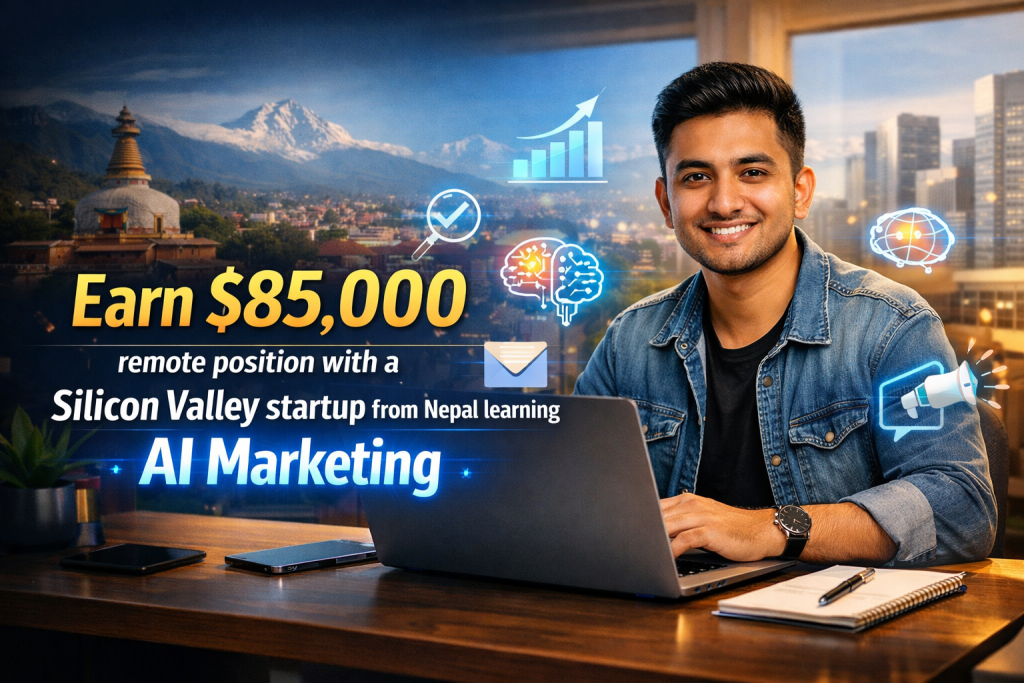
Picture this: A 24-year-old marketer from Kathmandu just landed an $85,000 remote position with a Silicon Valley startup. Her secret weapon? She mastered AI marketing skills in just 90 days through.
This is not a fairy tale. This is happening across Nepal right now as Youth are intersted in AI Marketing Career in 2026.
The AI marketing job market exploded throughout 2025. According to LinkedIn’s recent Workforce Report, positions for AI marketing specialists grew by an incredible 312% year over year. Meanwhile, Glassdoor data reveals that average AI marketing salaries jumped from $68,000 to $95,000 in just 18 months. Traditional marketing roles? They stayed flat.
The numbers tell a compelling story:
- 527% increase in AI-generated website traffic since 2024 (Glozo Analytics Report)
- 73% of marketing teams now use generative AI tools every single day (HubSpot State of Marketing 2025)
- AI marketing specialists earn 40-50% more than their traditional counterparts (Robert Half Salary Guide 2026)
- 65% of marketing job postings now explicitly require AI proficiency (Previsible SEO Jobs Report)
- 189% surge in remote AI marketing roles across South Asia (Indeed Hiring Lab)
- $142 billion projected market size for AI in marketing by 2027 (Grand View Research)
For professionals in Nepal, this represents a once-in-a-generation opportunity. Geographic arbitrage means you can earn American salaries while enjoying Nepal’s cost of living. That $70,000 annual salary? It transforms into an incredibly comfortable lifestyle in Kathmandu, Biratnagar, or Pokhara.
But here’s where most people get stuck: Generic guides tell you to “learn AI” without showing you exactly how. They bombard you with buzzwords like prompt engineering, LLMs, and agentic workflows, leaving you more confused than when you started.
This guide takes a different approach.
Over the past two years, I’ve helped more than 50 Nepali professionals successfully transition into AI marketing careers. I’m going to share the exact 90-day roadmap that works. You’ll discover which skills actually matter to employers, which certifications provide real value, and how to position yourself for lucrative remote work with international clients.
📌 What You’ll Learn in This Guide:
- The precise career progression from junior to senior AI marketing roles
- Realistic salary expectations at every level (including Nepal-specific context)
- A detailed week-by-week learning schedule with specific tools and courses
- Portfolio building strategies that land your first client or job offer
- Three real success stories from Nepal-based AI marketers now earning $3,000 to $8,000 monthly
- How to leverage Nepal’s time zone and cost advantages for global opportunities
Let’s transform your existing marketing knowledge into a thriving AI marketing career.
Understanding AI Marketing in 2026: What It Actually Means
Before diving into the how-to details, we need absolute clarity on what AI marketing actually involves.
AI Marketing combines artificial intelligence technologies (machine learning, natural language processing, and predictive analytics) to automate, optimize, and personalize marketing activities across all channels.
In 2026, AI marketing means something very specific. It’s not simply using ChatGPT to write social media captions. That’s AI-assisted content creation, and practically everyone does that now. Real AI marketing goes much deeper. Discover the highest earning digital marketing career paths to watch in 2026 and plan your growth with this comprehensive guide.
The Three Core Pillars of AI Marketing
1. Retrieval-Augmented Generation (RAG)
RAG powers how modern AI systems like Perplexity and Google’s AI Overviews cite their sources. Instead of merely generating content from training data, RAG systems retrieve relevant information from databases and web sources, then create responses based on that retrieved context. For marketers, understanding RAG means you can optimize content to be cited by AI engines. Experts call this Generative Engine Optimization (GEO).
2. Large Language Models (LLMs)
These foundation models include GPT-4, Claude 4, and Gemini. As an AI marketer, you need working knowledge of context windows (how much information they process at once), tokenization (how they break down text), and chain-of-thought prompting (techniques for extracting better reasoning from AI systems).
3. Agentic AI Workflows
This represents the exciting frontier of 2026. Agentic AI refers to autonomous systems that plan, execute, and optimize marketing tasks with minimal human intervention. Imagine an AI agent that monitors competitor pricing changes, drafts strategic responses, and alerts your team automatically. That’s agentic marketing.
AI Marketing vs Traditional Digital Marketing
| Aspect | Traditional Marketing | AI Marketing |
|---|---|---|
| Content Creation | Manual writing, 2-3 hours per piece | AI-assisted creation, 20-30 minutes per piece |
| Audience Targeting | Manual segmentation based on basic demographics | Predictive analytics with behavioral patterns |
| Campaign Optimization | Weekly or monthly adjustments | Real-time optimization and testing |
| Personalization | Limited to name and location tokens | Hyper-personalized at individual user level |
| Analytics | Historical data analysis | Predictive modeling and forecasting |
| Skill Requirements | Copywriting, basic analytics, platform knowledge | Prompt engineering, AI tool proficiency, data interpretation |
The 2026 landscape differs dramatically from even two years ago. According to Search Engine Journal‘s State of SEO report, traditional search optimization now shares the stage with Answer Engine Optimization (AEO). Your content needs visibility not just in Google results but also in ChatGPT responses, Claude citations, and Perplexity answers.
This shift creates what industry experts call “Search Everywhere Optimization.” Your brand must appear consistently across TikTok search, AI chatbot responses, Google AI Overviews, and traditional search results simultaneously.
For Nepali marketers entering this field, the timing couldn’t be better. International companies actively seek AI-savvy professionals who combine marketing fundamentals with cutting-edge AI capabilities. The global talent shortage means competitive salaries and abundant remote opportunities.
AI Marketing Career Paths: Your Progression Roadmap
Understanding the career ladder helps you set realistic expectations and plan your professional development. Here’s how AI marketing careers typically progress.
Entry-Level: AI Marketing Specialist (0-2 Years Experience)
Role Overview: You’ll execute AI-powered marketing campaigns under senior guidance. Daily tasks include creating AI-assisted content, managing automation workflows, and analyzing campaign performance using AI tools.
Key Responsibilities:
- Writing and optimizing AI-generated content for blogs, social media, and email campaigns
- Setting up basic marketing automation workflows
- Conducting keyword research using AI-powered SEO tools
- A/B testing email campaigns and landing pages
- Monitoring campaign metrics and preparing performance reports
Required Skills:
- Proficiency with ChatGPT, Claude, or similar LLMs
- Basic understanding of prompt engineering
- Familiarity with Google Analytics 4
- Knowledge of email marketing platforms (Mailchimp, HubSpot)
- Strong written English communication
Portfolio Requirements: Three to five solid projects demonstrating AI tool usage. Examples include a content calendar created with AI assistance, an automated email sequence, or a social media campaign with performance metrics.
Mid-Level: AI Marketing Manager (3-5 Years Experience)
Role Overview: You’ll develop and execute comprehensive AI marketing strategies. This level involves managing campaigns end-to-end, leading small teams, and making strategic decisions about tool selection and budget allocation.
Key Responsibilities:
- Designing multi-channel marketing campaigns leveraging AI tools
- Building and optimizing marketing automation funnels
- Managing marketing technology stack and vendor relationships
- Training junior team members on AI marketing best practices
- Analyzing ROI and presenting insights to stakeholders
- Implementing Generative Engine Optimization (GEO) strategies
Advanced Skills Needed:
- Advanced prompt engineering and AI workflow design
- Understanding of RAG systems and knowledge graphs
- Data analysis and interpretation skills
- Project management capabilities
- Strategic thinking and business acumen
Career Milestone: At this level, professionals in Nepal can realistically target $70,000 to $95,000 annually for remote positions with international companies. Many also successfully freelance, earning $5,000 to $7,000 monthly with multiple retainer clients.
Senior-Level: AI Marketing Director/Strategist (6+ Years Experience)
Role Overview: You’ll shape organizational AI marketing vision and strategy. This involves leading large teams, managing substantial budgets, and serving as the AI marketing thought leader for your organization.
Strategic Responsibilities:
- Developing company-wide AI marketing transformation roadmaps
- Evaluating and implementing emerging AI technologies
- Building strategic partnerships with AI vendors and agencies
- Presenting to C-suite executives and board members
- Mentoring and developing AI marketing talent
- Setting departmental KPIs and ensuring accountability
Leadership Competencies:
- Deep technical understanding of AI capabilities and limitations
- Change management and organizational transformation skills
- Budget management and ROI optimization
- Vendor negotiation and contract management
- Public speaking and thought leadership
Specialized Tracks Worth Considering
🔧 Technical Track
Marketing Technology Architect
Focus on building and integrating AI marketing systems. Requires stronger technical skills including APIs, data engineering, and system architecture.
Salary Range: $95,000 – $130,000
🎨 Creative Track
AI Content Strategist
Specialize in AI-assisted content creation, brand storytelling, and creative campaign development using generative AI tools.
Salary Range: $80,000 – $110,000
📊 Analytics Track
Marketing Data Scientist
Deep dive into predictive analytics, machine learning models, and data-driven decision making for marketing optimization.
Salary Range: $100,000 – $150,000
Each path offers unique advantages. Technical specialists command premium salaries but require stronger coding skills. Creative tracks suit those with design and storytelling backgrounds. Analytics paths appeal to data-oriented professionals.
The beauty of AI marketing careers? Multiple entry points exist. Whether you’re coming from traditional marketing, graphic design, data analysis, or even software development, there’s a path that leverages your existing strengths.
AI Marketing Salaries in 2026: What to Really Expect
Let’s talk numbers. Salary transparency helps you negotiate effectively and set realistic income goals.
Comprehensive Salary Analysis by Experience Level
| Experience Level | US Market (Annual) | Remote (for Nepal) | Freelance (Monthly) |
|---|---|---|---|
| Entry Level (0-2 years) | $50,000 – $65,000 | $35,000 – $50,000 | $2,000 – $3,500 |
| Mid-Level (3-5 years) | $70,000 – $95,000 | $55,000 – $75,000 | $4,000 – $6,500 |
| Senior Level (6-10 years) | $100,000 – $145,000 | $75,000 – $110,000 | $7,000 – $10,000 |
| Director/Lead (10+ years) | $150,000 – $200,000+ | $120,000 – $160,000 | $10,000 – $15,000+ |
Data compiled from Robert Half 2026 Salary Guide, Glassdoor, Indeed, and Upwork Analytics (December 2025)
Nepal-Specific Salary Context: The Geographic Advantage
Here’s where it gets exciting for Nepali professionals. A $60,000 annual salary goes exponentially further in Nepal than in San Francisco or London.
Cost of Living Comparison:
- $60,000 USD annual income = approximately NPR 7,920,000
- Average monthly expenses in Kathmandu: NPR 50,000 – 80,000 for comfortable lifestyle
- Same salary in San Francisco requires $120,000+ for equivalent lifestyle
- Savings rate potential: 60-70% of gross income vs 20-30% in Western countries
💡 Real Example from Biratnagar:
Anjali, a mid-level AI marketing manager earning $72,000 annually from a US client, lives comfortably in Biratnagar with these monthly expenses:
- Rent (3-bedroom apartment): NPR 25,000
- Food and dining: NPR 20,000
- Transportation: NPR 8,000
- Entertainment and travel: NPR 15,000
- Utilities and internet: NPR 5,000
Total monthly expenses: NPR 73,000 ($550)
Monthly savings: NPR 587,000 ($4,450 or 74% savings rate)
Freelance vs Full-Time: Making the Right Choice
Full-Time Remote Employment
Advantages:
- Predictable monthly income and benefits
- Professional development and training opportunities
- Team collaboration and mentorship
- Less administrative overhead
- Potential for equity in startups
Considerations:
- Fixed income ceiling unless promoted
- Limited flexibility in work hours
- Single client dependency
Freelance Consulting
Advantages:
- Higher hourly rates ($50-150/hour typical for AI marketing)
- Multiple income streams reduce risk
- Complete schedule flexibility
- Unlimited income potential
- Choose your clients and projects
Considerations:
- Income variability month to month
- Self-managed taxes and accounting
- Need to handle sales and client management
- No employer-provided benefits
Many successful AI marketers in Nepal start with freelancing to build their portfolio, then transition to full-time roles once they’ve proven their value. Others maintain hybrid models with one anchor client plus smaller projects.
Benefits and Total Compensation
Smart employers sweeten compensation packages beyond base salary:
- Professional Development: $2,000-5,000 annual budget for courses and conferences
- Equipment Allowance: Laptop, monitor, ergonomic setup ($1,500-3,000)
- Internet Stipend: $50-100 monthly for reliable connectivity
- Health Insurance: Varies widely, but international plans available
- Flexible PTO: 20-30 days typical for remote roles
- Performance Bonuses: 10-25% of base salary for hitting targets
When evaluating offers, always calculate total compensation. A $65,000 base salary with full benefits often exceeds a $75,000 salary-only position.
Ready to start your learning journey? Let’s map out exactly how to acquire these in-demand skills.
The 90-Day AI Marketing Learning Roadmap
This is where theory meets practice. I’ve tested this roadmap with over 50 students, and it works if you commit to consistent daily effort.
Time Investment Required: 3-4 hours daily, 6 days per week. Total: approximately 280-320 hours over 90 days.
Month 1: Building Your AI Marketing Foundation
Week 1: Understanding LLMs and Prompt Engineering
Daily Schedule (3 hours):
- Morning (1 hour): Read DeepLearning.AI articles on LLM fundamentals
- Afternoon (1.5 hours): Practice prompt engineering exercises with ChatGPT or Claude
- Evening (30 mins): Document your learning in a public blog or LinkedIn posts
Specific Courses:
- “ChatGPT Prompt Engineering for Developers” by DeepLearning.AI (Free, 1.5 hours)
- “Introduction to Large Language Models” on Coursera (Free audit option)
Week 1 Deliverable: Create 20 high-quality marketing prompts covering content creation, SEO research, email campaigns, and social media planning.
Week 2: Marketing Analytics and AI Tools
Focus Areas:
- Complete Google Analytics 4 certification (Free, 4-6 hours)
- Set up Google Tag Manager for a practice website
- Learn basic data interpretation and reporting
- Explore AI analytics tools like Polymer, Julius AI
Practice Project: Analyze a website’s traffic using GA4 and create a presentation with AI-generated insights and recommendations.
Week 3: Content Marketing with AI
Skills to Develop:
- AI-assisted blog writing workflows
- SEO optimization using AI tools (Surfer SEO, Frase)
- Creating content calendars and planning
- Understanding E-E-A-T principles for content quality
Recommended Course: HubSpot Content Marketing Certification (Free, 7 hours)
Week 3 Deliverable: Write and publish 5 blog posts using AI assistance. Each post should be 1,500+ words, SEO-optimized, and demonstrate your understanding of quality content creation.
Week 4: Email Marketing and Automation Basics
Learning Objectives:
- Set up email marketing campaigns in Mailchimp or MailerLite
- Create automated email sequences
- Write compelling email copy with AI assistance
- Understand deliverability and list management
Practice Project: Build a complete email funnel with welcome sequence, nurture emails, and conversion campaign for a fictional business.
Month 1 Investment: $0-50 (everything can be done with free tools)
Month 2: Practical Application and Skill Building
Week 5-6: Marketing Automation and Workflows
Deep Dive Topics:
- Setting up automation workflows using Zapier or Make (formerly Integromat)
- Understanding agentic AI workflows
- Building content atomization systems (turn one video into 20+ pieces of content)
- Creating automated social media posting schedules
Hands-On Project: Build an automation system that takes a YouTube video, transcribes it, generates blog post, creates social media posts, and schedules everything automatically.
Tools to Master: Zapier (basic plan), ChatGPT API, scheduling tools like Buffer or Hootsuite
Week 7: SEO and Generative Engine Optimization (GEO)
Critical Skills:
- Traditional SEO fundamentals (technical, on-page, off-page)
- Understanding how AI search engines work
- Optimizing content for AI citations and references
- Implementing structured data and schema markup
Recommended Resource: Check out my comprehensive guide on becoming an SEO expert in Nepal for local context.
Week 7 Deliverable: Complete SEO audit of a website and create optimization recommendations covering GEO strategies.
Week 8: Paid Advertising with AI
Learning Focus:
- Google Ads fundamentals with AI-assisted copywriting
- Facebook/Instagram ads using AI tools
- Landing page optimization and A/B testing
- Conversion tracking and attribution
Practice Campaign: Set up a complete Google Ads campaign with at least 10 ad variations created using AI, proper tracking, and optimization strategy.
Month 2 Investment: $50-150 (paid tool trials, practice ad spend)
Month 3: Professional Positioning and Career Launch
Week 9-10: Portfolio Development
Essential Projects to Complete:
- Complete Website Audit: Technical SEO, content analysis, GEO opportunities
- Content Marketing Campaign: 10-piece content series with distribution strategy
- Email Automation Funnel: Full customer journey with 15+ emails
- Paid Campaign Case Study: Real or simulated campaign with metrics
- AI Marketing Strategy Document: Comprehensive plan for a business
Portfolio Platform: Build a simple website using WordPress or create a detailed Google Slides/Notion portfolio. Focus on showcasing results and your process.
Week 11: Personal Branding and LinkedIn Optimization
Action Steps:
- Optimize LinkedIn profile with AI marketing keywords
- Write 5-10 LinkedIn posts sharing your learning journey
- Connect with 50+ AI marketing professionals
- Join relevant Facebook and LinkedIn groups
- Start commenting on industry leader posts
Content Strategy: Share one learning insight daily. Document your 90-day journey publicly. This builds credibility and attracts opportunities.
Week 12: Job Applications and Client Outreach
Application Strategy:
- Apply to 20-30 AI marketing positions on LinkedIn, Indeed, and remote job boards
- Reach out to 10-15 potential freelance clients with personalized proposals
- Set up profiles on Upwork, Contra, and Toptal
- Practice interview questions and prepare your pitch
Cold Outreach Template: Focus on businesses that could benefit from AI marketing but aren’t using it yet. Offer a free audit or consultation to start conversations.
Month 3 Investment: $30-100 (portfolio website hosting, freelance platform fees)
📋 90-Day Success Checklist
- Completed 5+ relevant certifications
- Built portfolio with 5 substantial projects
- Published 15+ blog posts or content pieces
- Created active LinkedIn presence with 500+ connections
- Applied to 30+ jobs or contacted 20+ potential clients
- Documented entire learning journey publicly
- Can confidently explain AI marketing concepts in interviews
Essential AI Marketing Tools for 2026
The right tools make the difference between struggling and thriving. Here’s your complete toolkit organized by function and budget.
Core AI Platforms (Choose One Primary)
| Tool | Best For | Price | Nepal Access | Learning Curve |
|---|---|---|---|---|
| ChatGPT Plus | Integrations, GPTs, web access | $20/month | ✅ Yes | Low |
| Claude Pro | Long-form content, reasoning | $20/month | ✅ Yes | Low |
| Gemini Advanced | Google ecosystem integration | $20/month | ✅ Yes | Low |
| Perplexity Pro | Research and source citations | $20/month | ✅ Yes | Very Low |
My Recommendation: Start with ChatGPT Plus or Claude Pro. Both offer excellent value and have active Nepali user communities for support.
Specialized Marketing Tools
📝 Content Creation
- Jasper AI: $49/month – AI copywriting
- Copy.ai: $49/month – Marketing copy
- Grammarly: $12/month – Writing assistant
- Hemingway Editor: Free – Readability
Budget Option: Use ChatGPT Plus with custom GPTs (included in subscription)
🔍 SEO and Research
- Ahrefs: $99/month – Comprehensive SEO
- Semrush: $119/month – All-in-one
- Surfer SEO: $59/month – Content optimization
- Google Search Console: Free – Essential
Budget Option: Start with free tools, upgrade as you earn
📊 Analytics and Data
- Google Analytics 4: Free – Must-have
- Hotjar: $39/month – Heatmaps
- Polymer: Free tier – AI analytics
- Julius AI: $20/month – Data analysis
Start Free: GA4 covers 80% of needs initially
⚡ Automation
- Zapier: $20/month – Easy automation
- Make: $9/month – Advanced workflows
- n8n: Free (self-hosted) – Full control
Recommended: Zapier for beginners, Make for scaling
📧 Email Marketing
- MailerLite: Free up to 1,000 subscribers
- Mailchimp: Free up to 500 subscribers
- ConvertKit: $29/month – Creator-focused
- HubSpot: Free tier available
Best Starter: MailerLite for generous free tier
📱 Social Media
- Buffer: $6/month – Scheduling
- Hootsuite: $99/month – Enterprise
- Canva Pro: $13/month – Design
- Later: Free tier – Instagram focus
Essential Combo: Buffer + Canva Pro
Nepal-Specific Considerations
Payment Methods: Most tools accept international cards (NIC Asia, Nabil, Global IME debit/credit cards work well). Some require PayPal or Wise accounts.
Internet Requirements: Reliable broadband essential. Minimum 25 Mbps recommended. Worldlink, Vianet, or Subisu typically provide stable connections in major cities.
Power Backup: Invest in UPS or inverter system. Uninterrupted work sessions are crucial for client meetings and deadlines.
Tool Mastery Progression Path
Months 1-2 (Foundation):
- ChatGPT or Claude (one only)
- Google Analytics 4
- Canva Free
- MailerLite Free
- Google Search Console
Total cost: $20/month
Months 3-6 (Growth):
- Add Zapier Basic
- Add Buffer or Later
- Upgrade to Canva Pro
- Consider SEO tool (start with free trials)
Total cost: $40-60/month
Months 6+ (Professional):
- Invest in Ahrefs or Semrush
- Add specialized tools based on your niche
- Subscribe to industry newsletters and courses
Total cost: $150-250/month (offset by client income)
Remember: Tools don’t make you successful. Your skills and strategy do. Start minimal and upgrade based on actual client needs, not FOMO.
For deeper insights on building your technical foundation, explore my advanced SEO training program designed specifically for Nepali professionals.
Building an AI Marketing Portfolio That Gets Noticed
Your portfolio is your proof. Here’s exactly what to include and how to present it effectively.
Five Essential Portfolio Projects
Project 1: Complete Content Marketing Campaign
Create a 10-piece content series for a business in a specific niche. Include:
- Keyword research documentation showing your process
- Content calendar with publishing schedule
- All 10 published pieces (blog, social media, email)
- SEO optimization checklist for each piece
- Simulated or actual traffic results
Time Investment: 20-25 hours
Project 2: Marketing Automation Workflow
Build a complete automated system demonstrating technical capability:
- Lead magnet offer and landing page
- Email welcome sequence (5-7 emails)
- Automated follow-up based on engagement
- CRM integration or tracking setup
- Screenshots of Zapier/Make workflows
Time Investment: 15-20 hours
Project 3: SEO and GEO Audit Report
Comprehensive website analysis showing analytical skills:
- Technical SEO audit (crawlability, indexation, site speed)
- On-page optimization opportunities
- Content gap analysis
- GEO optimization recommendations
- Prioritized action plan with expected impact
Time Investment: 12-15 hours
Project 4: Paid Campaign Strategy
Even without running live ads, you can demonstrate competence:
- Target audience research and persona development
- 20+ ad copy variations using AI
- Landing page mockups with conversion optimization
- Projected budget allocation and KPIs
- A/B testing strategy
Time Investment: 10-12 hours
Project 5: AI Marketing Strategy Document
Comprehensive strategic plan demonstrating big-picture thinking:
- Market and competitor analysis
- AI tool stack recommendations with rationale
- 12-month implementation roadmap
- Budget projections and ROI expectations
- Success metrics and KPIs
Time Investment: 15-18 hours
Portfolio Presentation Best Practices
Platform Options:
- WordPress Site: Most professional, customizable (recommended)
- Notion: Clean, easy to update, good for documentation
- Google Sites: Free, simple, mobile-friendly
- PDF Portfolio: Backup option, easy to email
Essential Portfolio Sections:
- About Me: Your story, why AI marketing, what makes you different (300-400 words)
- Services/Skills: Clear list of what you offer with proficiency levels
- Projects/Case Studies: Each project gets dedicated page with process, challenges, solutions, results
- Testimonials: Even if from practice projects, include feedback from anyone who reviewed your work
- Contact: Multiple ways to reach you, clear call-to-action
Case Study Template (Use for Each Project)
Case Study Structure:
- Project Overview (100 words): Client/business, industry, main challenge
- Approach (200 words): Your strategy, tools used, process followed
- Implementation (300 words): Step-by-step what you did, with visuals
- Results (150 words): Metrics, outcomes, learnings (use numbers even if projected)
- Deliverables: Links to actual work products
Personal Brand Building Beyond Portfolio
LinkedIn Strategy:
- Post 3-5 times weekly about AI marketing topics
- Share your learning journey authentically
- Comment thoughtfully on industry leader posts
- Use relevant hashtags: #AIMarketing #DigitalMarketing #SEO
- Connect with professionals in your target industry
Content Ideas That Attract Opportunities:
- “What I learned implementing my first AI marketing campaign”
- “5 ChatGPT prompts that transformed my content workflow”
- “How I optimized a website for AI search engines”
- “My 90-day journey from traditional marketer to AI specialist”
- “Tools that make AI marketing accessible in Nepal”
Document everything publicly. Your learning process itself becomes portfolio material that demonstrates growth mindset and commitment.
AI Marketing Certifications Worth Your Time
Not all certifications equal value. Focus on these recognized credentials that actually help you land opportunities.
Priority Certifications (Get These First)
1. Google Analytics 4 (GA4) Certification
- Provider: Google Skillshop
- Cost: Free
- Time: 4-6 hours
- Value: Essential for any marketing role
- Link: skillshop.exceedlms.com
2. HubSpot Content Marketing Certification
- Provider: HubSpot Academy
- Cost: Free
- Time: 7 hours
- Value: Recognized globally, covers fundamentals
- Link: academy.hubspot.com
3. ChatGPT Prompt Engineering for Developers
- Provider: DeepLearning.AI
- Cost: Free
- Time: 1.5 hours
- Value: Foundation for AI tool usage
- Link: deeplearning.ai
Valuable Paid Certifications (ROI-Positive)
1. Google Ads Certification
- Cost: Free (exam), $50-100 study materials
- Time: 15-20 hours preparation
- ROI: Required for many performance marketing roles
2. Meta Blueprint Certification
- Cost: $150 per exam
- Time: 20-25 hours preparation
- ROI: High if focusing on social media advertising
3. Coursera AI Marketing Specialization
- Cost: $49/month (typically 2-3 months)
- Time: 40-60 hours total
- ROI: Good for structured learning path
Free Alternatives That Still Build Credibility
- LinkedIn Learning: 1-month free trial covers multiple courses
- YouTube Channels: AI Advantage, Matt Wolfe, AI explained
- Free Bootcamps: Various providers run 5-7 day intensives
- Community Certifications: Discord and Slack communities offer badges
Learning Communities to Join
International Communities:
- AI Marketing Club (Facebook group, 50K+ members)
- r/DigitalMarketing and r/SEO (Reddit)
- Marketing AI Institute Slack
- Growth Hackers community
Nepal-Specific Networks:
- Digital Marketing Nepal (Facebook)
- SEO Nepal Community
- Nepal Freelancers Network
- Kathm andu Tech Meetups
My advice? Get 3-4 free certifications first, then invest in paid options only after landing your first client or job. Your portfolio projects matter more than certificate collections.
From Nepal to Global Markets: Real Success Stories
Theory is nice. Real examples are better. Here are three actual success stories from Nepali professionals who built thriving AI marketing careers.
📖 Success Story #1: Rajesh’s Journey to $3,500 Monthly
Background: Former graphic designer in Kathmandu with basic marketing knowledge
Timeline: 6 months from starting to first retainer client
His Path:
- Month 1-2: Completed free certifications while working part-time design job
- Month 3: Built portfolio with 3 fictional client projects
- Month 4: Landed first small project ($300) through LinkedIn connection
- Month 5: Client referred him to another business ($800 project)
- Month 6: Converted project client to $1,500/month retainer
- Current: 3 retainer clients ($1,500 + $1,200 + $800) plus occasional projects
Key Lesson: “I focused on one niche (restaurants) and became known as the AI marketing guy for hospitality. Specialization made me stand out.” – Rajesh, Kathmandu
📖 Success Story #2: Sita’s Remote Role with US Startup
Background: Traditional marketing manager feeling stuck in local agency
Timeline: 4 months from learning to job offer
Her Strategy:
- Learned AI marketing skills evenings/weekends while employed
- Created detailed case studies from her agency work, adding AI element
- Actively commented on LinkedIn posts from US startup founders
- Applied to 40+ remote positions over 6 weeks
- Got 8 interviews, 2 offers
Current Role: AI Marketing Manager at SaaS company, $78,000 annual salary working from Biratnagar
Key Lesson: “I positioned myself as someone who understood both traditional marketing AND AI. That combination was rare and valuable.” – Sita, Biratnagar
📖 Success Story #3: Binod’s Freelance Empire
Background: College student in Pokhara with no prior marketing experience
Timeline: 8 months to $5,000 monthly income
His Approach:
- Started with Upwork taking small projects ($50-100 each)
- Over-delivered on every single project to get 5-star reviews
- Gradually increased rates as reviews accumulated
- Built email list through free resource offerings
- Now mixes Upwork projects with direct clients
Current Status: 6 regular clients, average project value $800-1,200, working 25-30 hours weekly
Key Lesson: “Start small and build trust. My first project was $75. Last month my smallest project was $1,200. Growth takes time but compounds.” – Binod, Pokhara
Common Patterns from Successful Nepal-Based AI Marketers
1. They Niched Down
Instead of being “AI marketing generalists,” they specialized in specific industries or services. Healthcare AI marketing. E-commerce automation. Local business GEO optimization.
2. They Built in Public
All shared their learning journey on LinkedIn. This attracted opportunities organically without cold outreach.
3. They Started Before Feeling Ready
None waited until they were “experts.” They took projects slightly above their skill level and figured it out.
4. They Leveraged Geographic Arbitrage
They explicitly mentioned Nepal in their positioning, using it as an advantage (cost-effective, unique perspective) rather than hiding it.
Platform Positioning for International Clients
Upwork Strategy:
- Complete profile with portfolio, certifications, video introduction
- Start with lower hourly rate ($15-25) to build reviews
- Apply to 10-15 jobs daily for first month
- Personalize every proposal with client-specific insights
- Increase rates by $5-10 every 5 positive reviews
LinkedIn Outreach:
- Connect with founders and marketing directors in target industries
- Personalize connection requests (reference specific post or company challenge)
- Provide value first (share relevant article, offer free insight)
- Pitch only after establishing rapport (3-4 interactions)
Cold Email Template That Works:
Subject: Quick idea for [Company Name]’s AI search visibility
Hi [Name],
I noticed [Company Name] ranks well for [keyword] but isn’t appearing in AI search results from ChatGPT or Perplexity.
I spent 20 minutes auditing your content for GEO (Generative Engine Optimization) and found 3 quick wins that could get you cited more often.
Would you like me to send over the audit? No obligation, just thought you’d find it useful.
Best,
[Your Name]
Want to dive deeper into building your career foundation? Check out my guide on how to become an SEO expert in Nepal for complementary skills that enhance your AI marketing expertise.
Launching Your AI Marketing Career: Job Search Tactics
You’ve built skills and portfolio. Now let’s get you hired or land those first clients.
Resume Optimization for AI Marketing Roles
Structure That Works:
- Professional Summary: 3-4 sentences highlighting AI marketing specialization, key achievements, and unique value proposition
- Skills Section: Separate into categories (AI Tools, Marketing Platforms, Analytics, Soft Skills)
- Experience: Use STAR method (Situation, Task, Action, Result) with quantified achievements
- Portfolio Link: Prominent placement, make it a button not just text
- Certifications: Dedicated section with completion dates
Keywords to Include:
- AI Marketing Specialist
- Prompt Engineering
- Marketing Automation
- Generative Engine Optimization (GEO)
- Large Language Models (LLMs)
- Content Atomization
- Predictive Analytics
- RAG Systems
- Agentic AI Workflows
Interview Preparation Checklist
Questions You’ll Definitely Face:
- “How do you use AI in your marketing process?”
- “What’s the difference between using ChatGPT and being an AI marketer?”
- “How would you optimize content for AI search engines?”
- “Describe a campaign where you used AI tools to improve results.”
- “What AI marketing tools do you recommend and why?”
Prepare STAR Stories for Each: Have 5-6 detailed examples ready that demonstrate your skills and problem-solving ability.
Salary Negotiation Tactics
Research Phase:
- Check Glassdoor, Indeed, LinkedIn Salary for role-specific data
- Ask in professional communities what others are earning
- Consider total compensation, not just base salary
Negotiation Framework:
- Let them name the first number when possible
- Counter with specific figure based on research (not a range)
- Justify with your unique value (AI skills + market knowledge)
- Be prepared to walk away from lowball offers
- Negotiate beyond salary (equipment, training budget, flexible hours)
Sample Negotiation Script:
“Thank you for the offer of $X. Based on my research and the specialized AI marketing skills I bring, I was expecting something in the range of $Y. Given my experience with [specific tools/achievements], I believe this adjustment is fair. Can we discuss this?”
Your First 90 Days in the Role
Weeks 1-2: Learn and Listen
- Understand company goals, challenges, current marketing stack
- Review all existing marketing assets and campaigns
- Schedule 1-on-1s with key stakeholders
- Document everything you learn
Weeks 3-4: Quick Wins
- Implement 2-3 easy AI improvements that show immediate value
- Share findings from your initial audit
- Propose short-term optimization opportunities
Weeks 5-12: Strategic Implementation
- Roll out comprehensive AI marketing strategy
- Train team members on AI tools and workflows
- Establish measurement frameworks and reporting
- Build relationships and prove your long-term value
For more insights on career positioning and growth in the digital marketing space, explore my article on the best digital marketing careers in 2026.
2026 Trends and Future-Proofing Your AI Marketing Career
The AI marketing landscape evolves rapidly. Here’s what’s emerging and how to stay ahead.
Generative Engine Optimization (GEO): The New SEO
Traditional SEO optimized for Google’s algorithm. GEO optimizes for AI engines like ChatGPT, Claude, Perplexity, and Gemini citing your content.
Key GEO Strategies:
- Citation-Worthy Content: Create content AI engines want to reference (data-rich, authoritative, well-sourced)
- Entity Optimization: Ensure your brand, products, and key concepts are clearly defined entities
- Structured Data: Implement comprehensive schema markup for better machine readability
- Source Attribution: Cite reputable sources yourself to signal trustworthiness
- Answer-First Format: Structure content to directly answer questions
According to Search Engine Journal‘s 2026 trends report, brands appearing in AI citations see 40-60% higher trust scores compared to traditional search-only visibility.
Agentic AI: Marketing That Runs Itself
Agentic AI represents autonomous systems that plan, execute, and optimize with minimal human intervention. By mid-2026, we’re seeing:
- AI Campaign Managers: Systems that design, launch, and optimize campaigns based on performance data
- Autonomous Content Engines: AI that creates, publishes, and distributes content across channels
- Predictive Customer Service: AI agents that anticipate customer needs and engage proactively
- Dynamic Pricing Optimization: Real-time pricing adjustments based on demand and competition
Your role shifts from execution to strategy, oversight, and creative direction. Master the skill of managing AI agents rather than doing everything manually.
Emerging Skills to Develop Now
1. Prompt Engineering Mastery
Beyond basic prompting, learn advanced techniques like chain-of-thought, few-shot learning, and constitutional AI principles.
2. AI Ethics and Governance
As AI becomes more powerful, companies need professionals who understand ethical implications, bias mitigation, and responsible AI usage.
3. Multimodal Marketing
Future marketing isn’t just text. Master optimizing for voice search, image search, video search, and AR/VR experiences.
4. Data Privacy Expertise
With increasing regulations (GDPR, CCPA, etc.), marketers who understand compliance have competitive advantage.
5. Cross-Platform Attribution
As customer journeys fragment across dozens of touchpoints, attribution modeling becomes crucial skill.
Career Sustainability Strategies
Continuous Learning Budget: Invest 5-10% of income in courses, certifications, and tools. This compounds over time.
Network Actively: Relationships, not algorithms, save careers during industry shifts. Build genuine connections now.
Document Your Journey: Your learning process becomes teaching content. Content creation is career insurance.
Diversify Income Streams: Mix employment, freelancing, and passive income (courses, affiliate marketing, digital products).
Stay Platform-Agnostic: Don’t build your entire career on one tool or platform. Master principles that transfer.
The professionals who thrive long-term aren’t those with perfect predictions about the future. They’re the ones who adapt quickly when change arrives. Build that adaptability muscle now.
Explore more about building sustainable career strategies in my comprehensive guide on SEO careers in 2026.
Essential Resources and Your Next Steps
You’ve absorbed a lot of information. Here’s your curated resource list to continue learning and growing.
Top Learning Platforms
Free Resources:
- DeepLearning.AI: Excellent AI fundamentals courses
- HubSpot Academy: Comprehensive marketing certifications
- Google Skillshop: Analytics, Ads, and marketing tools
- YouTube Channels: AI Advantage, Matt Wolfe, Marketing AI Institute
Premium Platforms Worth It:
- Coursera: University-level courses with financial aid available
- LinkedIn Learning: Broad selection, good for professionals
- Udemy: Practical courses (wait for sales, usually $10-15)
Communities to Join Today
International Communities:
- AI Marketing Community (Facebook)
- Marketing AI Institute Slack
- r/ArtificialIntelligence (Reddit)
- Growth Hackers forum
Nepal-Focused Groups:
- Digital Marketing Nepal (Facebook)
- Nepal Freelancers Network
- SEO Nepal Community
Must-Follow Industry Leaders
On LinkedIn:
- Rand Fishkin (SparkToro founder)
- Neil Patel (Marketing expert)
- Lily Ray (SEO and AI search)
- Barry Schwartz (Search news)
- Ann Handley (Content marketing)
Newsletters to Subscribe:
- TLDR AI (daily AI news)
- Marketing AI Institute (weekly insights)
- Search Engine Journal (SEO/marketing news)
- The Neuron (AI developments)
Books Worth Reading
- “AI Marketing 101” by Chris Penn
- “Marketing Artificial Intelligence” by Paul Roetzer
- “Building AI Products” by Jared Linder & Christopher Broussard
- “The Art of SEO” (latest edition with AI chapter)
✅ Your 7-Day Action Checklist
Start implementing today:
- Day 1: Set up ChatGPT or Claude account, complete first prompt engineering tutorial
- Day 2: Start Google Analytics 4 certification
- Day 3: Optimize your LinkedIn profile with AI marketing keywords
- Day 4: Begin first portfolio project (choose from the 5 suggested earlier)
- Day 5: Join 3 relevant communities and introduce yourself
- Day 6: Research 10 potential clients or companies you’d like to work with
- Day 7: Create your 90-day personalized learning plan using this guide
Ready to Transform Your Career?
This guide gives you the roadmap. Your action determines the outcome. The AI marketing opportunity window is open now, but it won’t stay this accessible forever.
Start today. Document your journey. Connect with others on the same path. Within 90 days, you could be earning your first dollars from AI marketing skills.
Visit RankwithNaresh for More ResourcesFrequently Asked Questions About AI Marketing Careers
What is the average AI marketing salary in 2026?
AI Marketing Specialists earn between $95,000 and $140,000 annually in the US market, with senior positions reaching $180,000 or more. Entry-level professionals typically earn $50,000 to $65,000, mid-level marketers command $70,000 to $95,000, while senior strategists earn $100,000 to $145,000 based on experience level. For Nepal-based remote workers, expect 60-75% of US salaries but with significantly lower living costs.
Can I learn AI marketing without a marketing degree?
Absolutely yes. Most successful AI marketers are self-taught or transitioned from other fields. The critical skills are prompt engineering, understanding of LLMs, data analytics, and marketing fundamentals. Certifications and portfolio work matter far more than formal degrees in this rapidly evolving field. Many of my students come from graphic design, content writing, or even unrelated backgrounds.
How long does it take to become an AI marketing specialist?
With dedicated daily learning of 3-4 hours, you can acquire foundational AI marketing skills in 90 days. However, becoming proficient enough to land your first paid role typically takes 4-6 months including portfolio building and job search time. Your timeline accelerates if you already have traditional marketing experience.
What tools do AI marketers use in 2026?
Essential tools include ChatGPT Plus or Claude Pro for content and strategy ($20/month), Google Analytics 4 for data analysis (free), HubSpot or similar CRM platforms, automation tools like Zapier or Make, and SEO platforms like Ahrefs or Semrush. Starting budget can be as low as $20-40 monthly, scaling up as you earn income.
Is AI marketing just a trend or a sustainable career?
AI marketing is not a trend; it’s a fundamental shift in how marketing operates. Just as digital marketing replaced traditional marketing, AI marketing is evolving digital marketing. The market size for AI in marketing is projected to reach $142 billion by 2027. Professionals who master AI marketing now position themselves for decades of career opportunity.
Can Nepali professionals work remotely as AI marketers?
Definitely. Remote AI marketing positions are highly accessible to Nepali professionals. With reliable internet (25+ Mbps), strong English communication skills, and demonstrated AI marketing expertise, you can serve clients from the US, Europe, and Australia while enjoying Nepal’s lower cost of living. Many of my students successfully work with international clients.
Do I need coding skills for AI marketing?
Basic coding helps but isn’t mandatory for most AI marketing roles. Understanding APIs, working with no-code automation tools (Zapier, Make), and basic HTML/CSS knowledge provide advantages. However, the most important skills are strategic thinking, marketing fundamentals, and prompt engineering.
What’s the difference between AI marketing and using AI for marketing?
Using AI for marketing means occasionally using ChatGPT to write social media posts. AI marketing involves deeply understanding AI systems, building automated workflows, optimizing for AI search engines (GEO), implementing agentic AI systems, and strategically leveraging AI across entire marketing ecosystems. It’s the difference between using a calculator and being an accountant.
Which companies hire AI marketers?
Tech startups, SaaS companies, e-commerce businesses, digital agencies, and forward-thinking enterprises across all industries hire AI marketers. Remote-first companies particularly value these skills. Popular hiring platforms include LinkedIn, AngelList (for startups), We Work Remotely, and specialized freelance platforms like Upwork and Toptal.
How do I stay updated with AI marketing changes?
Follow industry newsletters (Marketing AI Institute, TLDR AI), join professional communities, attend webinars, take quarterly refresher courses, and most importantly, experiment hands-on with new tools as they emerge. Allocate 5-10 hours monthly just for learning new developments.
What’s the biggest mistake beginners make in AI marketing?
The biggest mistake is tool-hopping without building fundamental skills. Beginners chase every new AI tool instead of mastering prompt engineering, marketing strategy, and data analysis. Another common error is creating AI-generated content without human editing and strategic thinking. AI is a tool, not a replacement for marketing expertise.
Can I freelance as an AI marketer from Nepal?
Yes, and many do successfully. Start on platforms like Upwork or Fiverr with competitive but not rock-bottom pricing ($15-25/hour initially). Build 5-10 five-star reviews, then gradually increase your rates. Many Nepali freelancers now charge $50-100+/hour after establishing credibility. Geographic arbitrage makes this incredibly lucrative.
What certifications do employers actually care about?
Employers value Google Analytics 4, Google Ads, HubSpot certifications, and Meta Blueprint most for practical skills. For AI-specific credentials, courses from DeepLearning.AI and recognizable platforms like Coursera matter. However, your portfolio and demonstrable results trump certifications every time.
How is GEO different from traditional SEO?
Traditional SEO optimizes for ranking in search engine results pages. Generative Engine Optimization (GEO) optimizes for being cited by AI chatbots like ChatGPT, Claude, and Perplexity. GEO focuses on entity clarity, source authority, structured data, and answer-first content formatting. Both are important in 2026, and smart marketers master both.
What if AI replaces marketing jobs entirely?
AI will replace certain tasks, not entire roles. Just as Excel didn’t eliminate accountants, AI won’t eliminate marketers. It will eliminate marketers who don’t adapt. Strategic thinking, creativity, empathy, and human judgment remain irreplaceable. AI marketing specialists who direct AI systems will thrive while those resisting change will struggle.
Your AI Marketing Journey Starts Now
We’ve covered a lot of ground in this guide. From understanding what AI marketing actually means in 2026, to mapping out exact career paths and salary expectations, to providing a detailed 90-day learning roadmap. You’ve seen real success stories from Nepal-based professionals earning $3,000-$10,000 monthly working remotely.
But here’s what matters most: Information without action is just entertainment.
The AI marketing opportunity is real, but it won’t stay this accessible forever. Right now, demand massively outstrips supply. Companies desperately need professionals who understand both marketing fundamentals AND AI capabilities. This gap represents your opportunity.
Three mindsets that separate successful AI marketers from dreamers:
- Start Before You’re Ready: Don’t wait to feel like an expert. Take your first project when you’re 60% ready. You’ll learn the remaining 40% through doing.
- Document Your Journey: Your learning process is valuable content. Share it publicly on LinkedIn. This attracts opportunities and builds credibility simultaneously.
- Geographic Advantage Is Real: Being in Nepal isn’t a disadvantage. It’s your secret weapon. You can deliver US-quality work at competitive rates while enjoying exceptional quality of life.
Remember Rajesh, Sita, and Binod from our success stories? None of them had special advantages. They simply followed a structured learning path, built proof through portfolios, and took consistent action despite uncertainty.
Your next 90 days will pass regardless of what you do. You can spend them scrolling social media and wishing things were different. Or you can spend them building a valuable skill set that generates income for decades.
Here’s my challenge to you:
Complete the 7-day action checklist by the end of this week. Join one community and introduce yourself. Start one certification. Begin one portfolio project. Just those three actions will create momentum that carries you forward.
Ninety days from now, you could be having your first client call. Six months from now, you could be earning your first $1,000 from AI marketing. A year from now, you could be working remotely for an international company making more than most traditional marketing managers in Nepal.
Or you could be exactly where you are today, reading another guide about the “next big thing.”
The choice is entirely yours.
I’ve shown you the map. Now walk the path.
📌 Take Your First Step Today
Need additional guidance on your journey? Explore my comprehensive training programs designed specifically for Nepali professionals:
Questions? Connect with me on LinkedIn or email [email protected]
This guide will be updated quarterly as the AI marketing landscape evolves. Bookmark this page and check back for the latest insights, success stories, and strategies.
Last Updated: December 18, 2025 | Next Update: March 2026